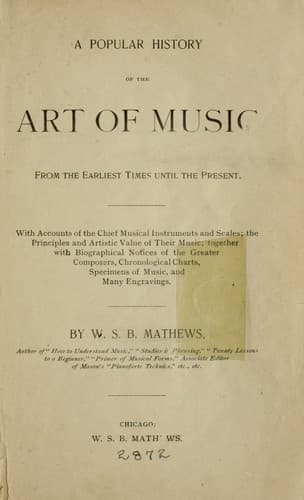
A Popular History of the Art of Music: From the Earliest Times Until the PresentMathews, W. S. B. (William Smythe Babcock)
History
A Popular History of the Art of Music: From the Earliest Times Until the Present
Mathews, W. S. B. (William Smythe Babcock)
Music -- History and criticism
every manner to reduce to paper the wonderful composition of his
dream. Fine as was the work thus produced, Tartini always maintained
that it fell far short of the glorious virtuoso piece which he had
heard.
Tartini was in some sort a forerunner of the modern romantic school.
He was accustomed to take a poem as the basis of an instrumental
piece. He wrote the words along the score and conducted the music
wherever the spirit of the words took it. He was also in the habit of
affixing to his published works mottoes, indicative of their poetic
intention. With this general characterization his music well agrees,
for in dreamy moods it has a mystical beauty till then unknown in
music. He is also entitled to lasting memory on account of his having
first discovered the phenomenon of "combination tones," the under
resultant which is produced when two tones are sounded together upon
the violin, especially in the higher parts of the compass. These tones
are the roots of the consonances sounding, and Tartini directed the
attention of his pupils to them as a guide to correct intonation in
double stops, since they do not occur unless the intonation is pure.
He made this important discovery about 1714, and in 1754 he published
a treatise on harmony embodying the combination tones as a basis of a
system of harmony. This having been violently attacked, his second
work of this kind, "On the Principles of Musical Harmony Contained in
the Diatonic Genus," was published in 1767. Tartini, therefore, must
be reckoned among the great masters who have contributed to a true
doctrine of the tonal system. Copies of his theoretical writings are
in the Newberry Library at Chicago.
Public-domain text, read in full here on John Shaqi.
Reviews
Reviews
No reviews yet
Be the first to share your thoughts on this work.
Elsewhere in the archive
Join the Discussion
Join the discussion
Sign in to leave a comment or review.
Sign InorCreate an account