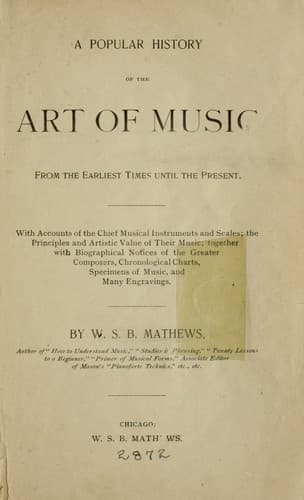
A Popular History of the Art of Music: From the Earliest Times Until the PresentMathews, W. S. B. (William Smythe Babcock)
History
A Popular History of the Art of Music: From the Earliest Times Until the Present
Mathews, W. S. B. (William Smythe Babcock)
Music -- History and criticism
In the latter part of the eighteenth century and the first of the next
following the art of violin playing was best illustrated by the German
artist, Louis Spohr (1784-1859), who was almost or quite as great as a
composer, as in his early career of a virtuoso. In his own specialty
he was one of the most eminent masters who has ever appeared. His
technique was founded upon that of his predecessors of the school of
Viotti and Rode, but his own individuality was so decided that he soon
found out a style original with himself. Its distinguishing quality
was the singing tone. He never reconciled himself to the light bow
introduced by Paganini, and all his work is distinguished by
sweetness, singing quality and a flowing melodiousness. He was fond of
chromatic harmonies and double stops, which imparted great sonority to
his playing. He was born at Brunswick, and early commenced to study
music. At the age of fifteen he played in the orchestra of the duke of
Brunswick, at a yearly salary of about $100. Later he studied and
traveled with Eck, a great player of the day, and upon his return to
Brunswick he became leader of the orchestra. His virtuoso career
commenced about 1803. Two years later he became musical director at
Gotha, where he married a charming harp player, Dorette Scheidler, who
invariably afterward appeared with him in all their concerts. They
traveled in their own carriage, having suitable boxes for the harp and
the violin. In 1813 he was musical director at the theater, "_An der
Wein_," at Vienna, where among his violinists was Moritz Hauptmann,
afterward so celebrated as theorist.
Public-domain text, read in full here on John Shaqi.
Reviews
Reviews
No reviews yet
Be the first to share your thoughts on this work.
Elsewhere in the archive
Join the Discussion
Join the discussion
Sign in to leave a comment or review.
Sign InorCreate an account