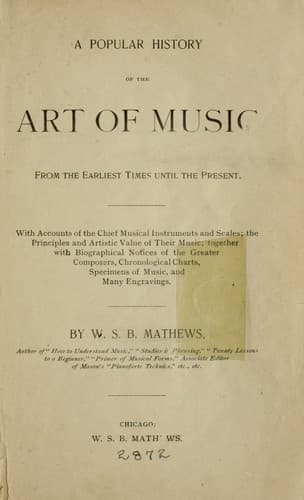
A Popular History of the Art of Music: From the Earliest Times Until the PresentMathews, W. S. B. (William Smythe Babcock)
History
A Popular History of the Art of Music: From the Earliest Times Until the Present
Mathews, W. S. B. (William Smythe Babcock)
Music -- History and criticism
During his residence in Vienna, Spohr met Beethoven many times. He was
one of the first to introduce the earlier quartettes, in his concerts
throughout Germany, and valued them properly. But in regard to the
Beethoven symphonies he placed himself on record in a highly
entertaining manner. He says of the melody of the famous "Hymn to
Joy," in Beethoven's ninth symphony, that it is so "monstrous and
tasteless, and its grasp of Schiller's ode so trivial, that I cannot
even now understand how a genius like Beethoven could have written
it."
[Illustration]
Book Fifth.
THE
Period of the Romantic.
WEBER, PAGANINI, SCHUBERT, BERLIOZ, MEYERBEER, MENDELSSOHN, SCHUMANN,
CHOPIN, LISZT, WAGNER; THE VIRTUOSI; MUSIC OF THE FUTURE.
CHAPTER XXXI.
THE NINETEENTH CENTURY, THE ROMANTIC; MUSIC OF THE FUTURE.
In ordinary speech a distinction is made between the musical
productions of the eighteenth century and those of the next following;
the former being called _Classic_, the latter _Romantic_. The terms
are used rather indefinitely. According to Hegel, whose teaching
coincided with the last years of Beethoven's life, the classic in art
embraces those productions in which the _general_ is aimed at, rather
than the _particular_; the _reposeful_ and _completely satisfactory_,
rather than the _forced_, or the _sensational_; and the _beautiful_
rather than the _exciting_. The philosopher Hegel, who was one of the
first to employ this distinction in art criticism, took his departure
from the famous group of Laocooen and his sons in the embrace of the
destroying serpents. This group, so full of agony and irrepressible
horror, belongs, he said, to a totally different concept of art from
that of the gods and goddesses of Greece, in the beauty and freshness
of their eternal youth. These qualities are those of the general and
the eternal; the Laocooen, in its nature painful, was not nor could be
permanently satisfactory in and of itself, but only through allowance
being made by reason of interest in the story told by it. According to
more recent philosophers, the romantic movement in literature and art
(for they are parts of the same general movement of the latter part of
the eighteenth century) has its essential characteristic in the
doctrine that what is to be sought in art is not the pleasing and the
satisfactory, so much as the true. _Everything_, they say, belonging
to life and experience, is fit subject of art; to the end that thereby
the soul may learn to understand itself, and come to complete
self-consciousness. The entire movement of the romantic writers had
for its moving principle the maxim, _Nihil humanum alienum a me puto_
("I will consider nothing human to be foreign to me"). Yet other
writers make the romantic element to consist of the striking, the
strongly contrasted, the exciting, and so at length the sensational.
Whichever construction we may put upon this much used and seldom
Public-domain text, read in full here on John Shaqi.
Reviews
Reviews
No reviews yet
Be the first to share your thoughts on this work.
Elsewhere in the archive
Join the Discussion
Join the discussion
Sign in to leave a comment or review.
Sign InorCreate an account