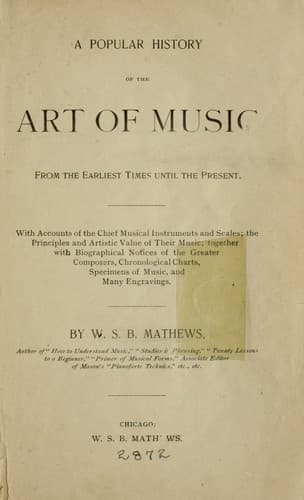
A Popular History of the Art of Music: From the Earliest Times Until the PresentMathews, W. S. B. (William Smythe Babcock)
History
A Popular History of the Art of Music: From the Earliest Times Until the Present
Mathews, W. S. B. (William Smythe Babcock)
Music -- History and criticism
Soon after his arrival in Vienna, Spohr received a singular
proposition from one Herr von Tost, to the effect "that for a
proportionate pecuniary consideration I would assign over to him all I
might compose, or had already written, in Vienna, for the term of
three years, to be his sole property during that time; to give him the
original scores, and to keep myself even no copy of them. After the
lapse of three years he would return the manuscript to me, and I
should then be at liberty either to publish or sell them. After I had
pondered a moment over this strange and enigmatical proposition, I
asked him whether the compositions were not to be played during those
three years? Whereupon Herr von Tost replied: 'Oh, yes! As often as
possible, but each time upon my lending them for that purpose, and
only in my presence.'" He desired such pieces as could be produced in
private circles, and would therefore prefer quartettes and quintettes
for stringed instruments, and sextettes, octettes and nonettes for
stringed and wind instruments. Spohr was to consider the proposition
and fix upon the sum to be paid for the different kinds of
compositions. Finding on inquiry that Herr von Tost was a wealthy man,
very fond of music, Spohr fixed the price at thirty ducats for a
quartette, thirty-five for a quintette, and so on, progressively
higher for the different kinds of composition. On being questioned as
to his object, Von Tost replied: "I have two objects in view: First, I
desire to be invited to the musical parties where you will execute
your compositions, and for that I must have them in my keeping.
Secondly, possessing such treasures of art, I hope upon my business
journeys to make extensive acquaintance among the lovers of music,
which may then serve me also in my manufacturing interests." This
singular bargain was duly consummated and faithfully carried out, and
the wealthy patron proved of great service to the Spohrs in procuring
their housekeeping outfit from various tradesmen with whom he had
dealings, and he would not suffer Spohr to pay for anything, saying
only, "Give yourself no uneasiness; you will soon square everything
with your compositions."
The most important of Spohr's works is his great school for the
violin, published in 1831. He left also a vast amount of chamber
music, fifteen concertos for violin and orchestra, nine symphonies,
four oratories, of which "The Last Judgment" is perhaps the best, ten
operas, many concert overtures, etc.--in all more than 200 works, many
of them of large dimensions. His best operas are "_Jessonda_" (1823),
"Faust" (1818), "The Alchemist" (1832) and "The Crusaders" (1845). His
orchestral works are richly instrumented, and the coloring is sweet
and mellow, yet at times extremely sonorous.
Public-domain text, read in full here on John Shaqi.
Reviews
Reviews
No reviews yet
Be the first to share your thoughts on this work.
Elsewhere in the archive
Join the Discussion
Join the discussion
Sign in to leave a comment or review.
Sign InorCreate an account