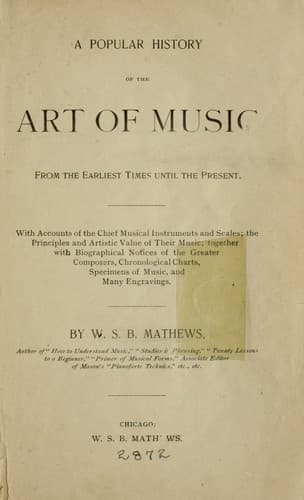
A Popular History of the Art of Music: From the Earliest Times Until the PresentMathews, W. S. B. (William Smythe Babcock)
History
A Popular History of the Art of Music: From the Earliest Times Until the Present
Mathews, W. S. B. (William Smythe Babcock)
Music -- History and criticism
Nor has virtuosity been confined to single instruments. There have
been two great virtuosi in orchestration, during this century, who
have exercised as great an influence in this complicated and elaborate
department, as the others mentioned have upon their own solo
instruments. The first of these was Hector Berlioz, the great French
master, whose earlier compositions were produced in 1835, when the
instruments of the orchestra were combined in vast masses, and with
descriptive intention, far beyond anything by previous writers. In his
later works, such as the "Damnation of Faust," and the mighty Requiem,
Berlioz far surpassed these efforts, every one of his effects
afterward proving to have been well calculated. Directly after his
early works came the first of that much discussed genius, Richard
Wagner, who besides being one of the most profound and acute
intelligences ever distinguished in music, and a great master of the
province of opera (in which he accomplished stupendous creations), was
also an orchestral virtuoso, coloring when he chose, with true
instinct, for the mere sake of color; and massing and contrasting
instruments in endless variety and beauty.
The activity in musical production during the nineteenth century has
been so extraordinary in amount and in the number of composers
concerned in it, and so ample in the range of musical effects brought
to realization, as fully to illustrate the truth of the principle
enunciated at the outset of this narrative, namely: That the course of
musical progress has been toward greater complication of tonal effects
in every direction; implying upon the part of composers the possession
of more inclusive principles of tonal unity; and upon the part of the
hearers, to whom these vast works have been addressed, the possession
of corresponding powers of tonal perception, and the persistence of
impressions for a sufficient length of time in each instance for the
underlying unity to be realized.
As an incident in the rapidity of the progress on the part of
composers, we have had what is called "the music of the future";
namely, productions of one generation intelligible to the finer
intelligences of that generation, yet "music of the future" to all the
others; but in the generation following, these compositions have gone
into the common stock, through the progress of the faculties of
hearing and of deeper perceptions of tonal relations. Meanwhile there
has been created another stratum of music of the future, which may be
expected to occupy the attention of the generation next ensuing, to
whom in turn it will become the music of the present.
Public-domain text, read in full here on John Shaqi.
Reviews
Reviews
No reviews yet
Be the first to share your thoughts on this work.
Elsewhere in the archive
Join the Discussion
Join the discussion
Sign in to leave a comment or review.
Sign InorCreate an account