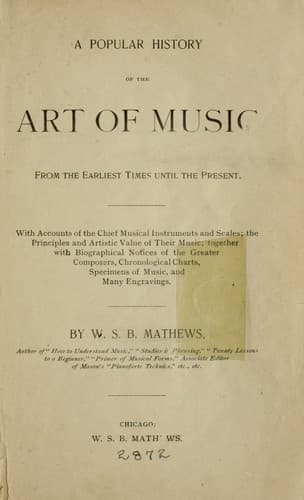
A Popular History of the Art of Music: From the Earliest Times Until the PresentMathews, W. S. B. (William Smythe Babcock)
History
A Popular History of the Art of Music: From the Earliest Times Until the Present
Mathews, W. S. B. (William Smythe Babcock)
Music -- History and criticism
In the nature of the case, there is not, nor can there be, a stopping
place, unless we conceive the possibility of a return to the
conservatism of Plato and the ancient Egyptians, and the passage of
statute laws permitting the employment of chords and rhythms up to a
certain specified degree of complexity, beyond which their use would
constitute a grave statutory offense. It is possible that the ideal of
art might again be "reformed" in the direction of restriction from the
uncomely, the forced and the sensational, and in favor of the
beautiful, the becoming and the divine. Nevertheless, it is the
inevitable consequence of a prescription of this kind to run into mere
prettiness and tuneful emptiness. Protection is a failure in art. The
spirit must have freedom, or it will never take its grandest flights.
And it is altogether possible that the needed corrective will
presently be discovered of itself, through the progress of spirit into
a clearer vision, a higher aspiration and a nobler sense of beauty.
This we may hope will be one of the distinctions of the coming ages,
which poets have foretold and seers have imagined, when truth and love
will prevail and find their illustration in a civilization conformed
of its own accord to the unrestricted outflowing of these deep,
eternal, divine principles.
[Illustration]
CHAPTER XXXII.
SCHUBERT AND THE ROMANTIC.
The first two great figures of the nineteenth century were those of
Carl Maria von Weber, whose work will be considered later, and the
great song writer, Franz Peter Schubert (1797-1828). This remarkable
man was born of poor parents in Vienna, or near it, his father being a
schoolmaster, earning the proverbially meager stipend of the
profession in Germany at that time, amounting to no more than $100 or
$200 a year. The family was musical, and the Sundays were devoted to
quartette playing and other forms of music. The boy Franz early showed
a fine ear. He was soon put to the study of the violin and the
piano--while still a mere child being furnished with a small violin,
upon which he went through the motions of his father's part. He had a
fine voice, and this attracted the attention of the director of the
choir in the great Cathedral of St. Stephen's, as it had in Haydn's
case, and he was presently enrolled as chorister and a member of what
was called the "Convict," a school connected with the church, where
the boys had schooling as well as musical instruction. Early he began
to write, among his first works being certain pieces for the piano and
violin, composed when he was a little more than eleven. In the
"Convict" school there was an orchestra where they practiced
symphonies and overtures of Haydn, Mozart, Kotzeluch, Cherubini,
Mehul, Krommer, and occasionally Beethoven. Here his playing
immediately put him on a level with the older boys. One of them turned
around one day to see who it was playing so cleverly, and found it "a
little boy in spectacles," named Franz Schubert.
Public-domain text, read in full here on John Shaqi.
Reviews
Reviews
No reviews yet
Be the first to share your thoughts on this work.
Elsewhere in the archive
Join the Discussion
Join the discussion
Sign in to leave a comment or review.
Sign InorCreate an account