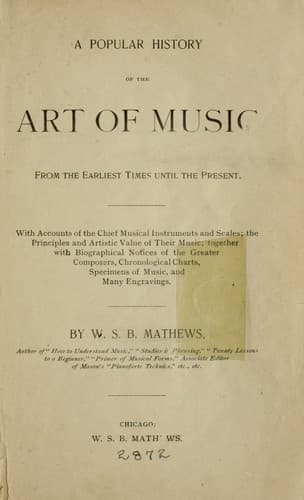
A Popular History of the Art of Music: From the Earliest Times Until the PresentMathews, W. S. B. (William Smythe Babcock)
History
A Popular History of the Art of Music: From the Earliest Times Until the Present
Mathews, W. S. B. (William Smythe Babcock)
Music -- History and criticism
Presently Schubert entered his father's school, in order to avoid the
rigorous conscription, and remained a teacher of the elementary
branches for three years. His first important composition was a mass,
which was produced honorably October 16, 1814, and many good judges
pronounced it equal to any similar work of the kind, excepting
possibly Beethoven's mass in C. By 1815 the rage of composition had
fully taken possession of the soul of Schubert, and thenceforth poured
out from this receptacle of inspiration a steady succession of works
of all dimensions and characters, very few of which were performed in
his lifetime. Among these works in the year 1815, there are 137 songs,
of which only sixty-seven are printed as yet. And in August alone
twenty-nine, of which eight are dated the 15th, and seven the 19th.
Among these 137 songs some are of such enormous length that this
feature alone would have prevented their publication. Of those
published, "_Die Burgschaft_" fills twenty-two pages of the Litolff
edition. It was the length of these compositions which caused
Beethoven's exclamation upon his death bed: "Such long poems, many of
them containing ten others." And this mass of music was produced in
the interim of school drudgery. Among these songs of his boyhood years
are "_Gretchen am Spinnrade_," "_Der Erl Koenig_," "Hedge Roses,"
"Restless Love," the "_Schaefer's Klaglied_," the "Ossian" songs, and
many others, all falling within the production of this year. It is
said that when the "Erl King" was tried in the evening, the listeners
at the convict thought it of questionable success. The music of the
boy at the words "My father, my father" seemed to be inexcusable, for
overwhelmed with fright, he sings a half a tone sharp of the
accompaniment.
At length, after about three years, Schubert's services as a
schoolmaster becoming less and less valuable, an opening was made for
him by Schober, who proposed that Schubert should live with him. He
was now free to devote himself to composition, and so thoroughly did
he do this that in the year following, 1816, he experienced the
novelty of having composed for money, a cantata of his having not only
been performed upon the occasion of Salieri's fiftieth anniversary of
life in Vienna, but money was sent him for it, 100 florins, Vienna
money, about $20 American. He was already composing operas, and in
1816 there was one, "_Die Burgschaft_," in three acts. In the same
year there were two symphonies, the fourth in C minor, called "The
Tragic," and the fifth for small orchestra. The songs of this year,
however, were of more value. Among them were the "Wanderer's Night
Song," the "Fisher," the "Wanderer" and many others now known wherever
melody and dramatic quality are appreciated.
Public-domain text, read in full here on John Shaqi.
Reviews
Reviews
No reviews yet
Be the first to share your thoughts on this work.
Elsewhere in the archive
Join the Discussion
Join the discussion
Sign in to leave a comment or review.
Sign InorCreate an account