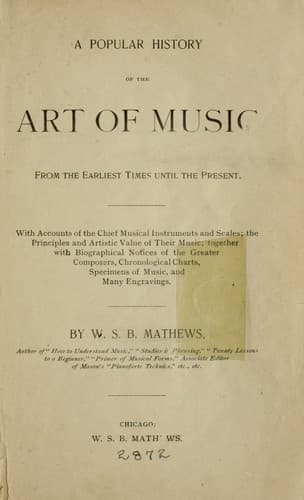
A Popular History of the Art of Music: From the Earliest Times Until the PresentMathews, W. S. B. (William Smythe Babcock)
History
A Popular History of the Art of Music: From the Earliest Times Until the Present
Mathews, W. S. B. (William Smythe Babcock)
Music -- History and criticism
The rapidity with which he composed songs was incredible. October,
1815, he finds the poems of Rosegarten, and between the 15th and 19th
sets seven of them. "Everything that he touched," says Schumann,
"turned into music." At a later date, calling upon one of his friends,
he found certain poems by Wilhelm Mueller, and carried them off with
him. A few days later, his friend desiring the book, called on
Schubert for it, and found that he had already set a number of them to
music. They were the songs of the "_Schoene Muellerin_." A year or so
after, returning from a day in the country, they stopped at a tavern,
where he found a friend with a volume of Shakespeare open before him.
Schubert took up the volume, turned a few pages, became interested in
one of the pieces, took up some waste paper, and scribbling the lines
proceeded to write a melody. This was the so-called "Shakespeare
Serenade," "Hark, Hark, the Lark." The "Serenade," in D minor, is said
to have been conceived in a similarly impromptu manner. In 1816 the
great tenor, Vogl, made Schubert's acquaintance, having been brought
by one of Schubert's admirers. At first the songs did not make much
impression upon him; later they grew upon him, and he introduced them
among the best circles of the Vienna aristocracy. Vogl appreciated the
value of these songs. "Nothing," said he, "so shows the want of a good
school of singing as Schubert's songs. Otherwise, what an enormous and
universal effect must have been produced throughout the world,
wherever the German language is understood, by these truly divine
inspirations, these utterances of musical clairvoyance. How many would
have comprehended for the first time the meaning of such terms as
speech and poetry in music; words in harmony, ideas clothed in music,
and would have learned that the finest poems of our greatest poets may
be enhanced and even transcended when translated into musical
language. Numberless examples might be named, but I will only mention
the 'Erl King,' 'Gretchen,' '_Schwager Kronos_,' 'The Mignon's and
Harper's Songs,' 'Schiller's Pilgrim,' the '_Burgschaft_' and the
'_Sehnsucht_.'"
Public-domain text, read in full here on John Shaqi.
Reviews
Reviews
No reviews yet
Be the first to share your thoughts on this work.
Elsewhere in the archive
Join the Discussion
Join the discussion
Sign in to leave a comment or review.
Sign InorCreate an account