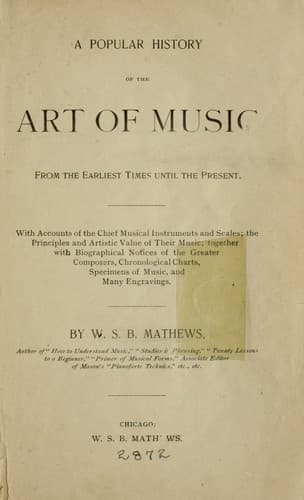
A Popular History of the Art of Music: From the Earliest Times Until the PresentMathews, W. S. B. (William Smythe Babcock)
History
A Popular History of the Art of Music: From the Earliest Times Until the Present
Mathews, W. S. B. (William Smythe Babcock)
Music -- History and criticism
and clumsy, with a round back and shoulders, perhaps due to incessant
writing, fleshy arms, thick, short fingers. His cheeks were full, his
eyebrows bushy and his nose insignificant. His hair was black, and
remarkably thick and vigorous, and his eyes were so bright that even
through the spectacles, which he constantly wore, they at once
attracted attention. His glasses were inseparable from his face. In
the convict he was the "little boy in spectacles." He habitually slept
in them. He was very simple in his tastes, timid and never really at
ease but in the society of his intimates and people of his own
station. His attitude toward the aristocracy was entirely different
from the domineering, self-assertive pose of Beethoven, but he was
very amiable, and dearly beloved.
[Illustration: Fig. 67.
FRANZ SCHUBERT.]
His place in the history of music, aside from the general fact of his
possessing genius of the first order, is that of the creator of the
artistic song. While his pianoforte sonatas are extremely beautiful
and very difficult, and anticipate many modern effects; his string
quartettes, and other chamber music, worthy to be ranked with those of
any other master; and his symphonies exquisitely beautiful in their
ideas, orchestral coloring and the entire atmosphere which they
carry--his habitual attitude was that of the writer of songs. Some of
these are of remarkable length and range. One of them extends to
sixty-six pages of manuscript. Another occupies forty-five pages of
close print. A work of this kind is a cantata, and not merely a song.
Many of the others are six or eight pages long, and in all the music
freely and spontaneously follows the poem, with a delicate
correspondence between the poetic idea and the melody, with its
harmony and treatment, such as we look for in vain in any other
writer, unless it be Schumann, who, however, did not possess
Schubert's instinct of the vocally suitable. For with all the range
which these songs cover, their vocal quality is as noticeable as that
of Italian cantilenas.
[Illustration]
CHAPTER XXXIII.
THE STORY OF THE PIANOFORTE.
Public-domain text, read in full here on John Shaqi.
Reviews
Reviews
No reviews yet
Be the first to share your thoughts on this work.
Elsewhere in the archive
Join the Discussion
Join the discussion
Sign in to leave a comment or review.
Sign InorCreate an account