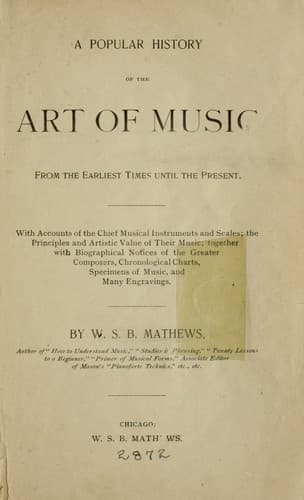
A Popular History of the Art of Music: From the Earliest Times Until the PresentMathews, W. S. B. (William Smythe Babcock)
History
A Popular History of the Art of Music: From the Earliest Times Until the Present
Mathews, W. S. B. (William Smythe Babcock)
Music -- History and criticism
pursued beyond the rudiments, and the last engagement he made before
his death was for lessons with Sechter, the contrapuntal authority in
Vienna at that time.
In spontaneity of genius Schubert resembles Mozart more than any other
master who ever lived. His early education and training were different
from those of Mozart, and musical ideas take different form with him.
While Mozart was distinctly a melodist, counterpoint and fugue were at
his fingers' ends, and his thematic treatment had all the freedom
which comes from a thorough training in the use of musical material.
Schubert had not this kind of training. He never wrote a good fugue,
and his counterpoint was indifferent; but on the other hand he had
several qualities which Mozart had not, and in particular a very
curious and interesting mental phenomenon, which we might call
psychical resonance or clairvoyance. Whatever poem or story he read
immediately called up musical images in his mind. Under the excitement
of the sentiment of a poem, or of dramatic incidents narrated, strange
harmonies spontaneously suggested themselves, and melodies exquisitely
appropriate to the sentiment he desired to convey. He was a musical
painter, whose colors were not imitated from something without
himself, but were inspired from within.
Schubert was a great admirer of Beethoven, and upon one occasion
called upon him with a set of works which he had dedicated to the
great master. Beethoven had been prepared for the visit by some
admirer of Schubert's, and received him very kindly, but when he began
to compliment the works the bashful Schubert rushed out of doors. Upon
another occasion during his last illness Beethoven desired something
to read, and a selection of about sixty of Schubert's songs, partly in
print and partly in manuscript, were put in his hands. His
astonishment was extreme, especially when he heard that there existed
about 500 of the same kind. He pored over them for days, and asked to
see Schubert's operas and piano pieces, but the illness returned, and
it was too late. He said "Truly Schubert has the divine fire in him."
Schubert was one of the torch bearers at Beethoven's funeral. In March
1828, he gave an evening concert of his own works in the hall of the
Musikverein. The hall was crowded, the concert very successful, and
the receipts more than $150, which was a very large sum for Schubert
in those days. For several months before his death Schubert's health
was delicate. Poverty and hard work, a certain want of encouragement
and ease had done their office for him. He died November 19, 1828. He
left no will. His personal property was sold at auction, the whole
amounting to about $12. Among the assets was a lot of old music valued
at ten florins. It is uncertain whether this included the unpublished
manuscript or not. In personal appearance Schubert was somewhat
insignificant. He was about five feet one inch high, his figure stout
Public-domain text, read in full here on John Shaqi.
Reviews
Reviews
No reviews yet
Be the first to share your thoughts on this work.
Elsewhere in the archive
Join the Discussion
Join the discussion
Sign in to leave a comment or review.
Sign InorCreate an account