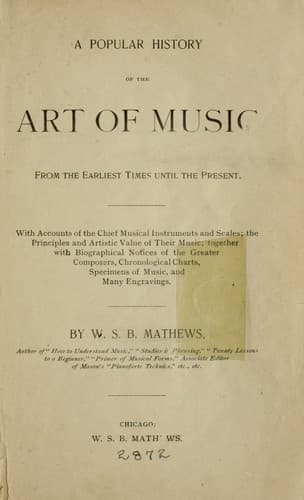
A Popular History of the Art of Music: From the Earliest Times Until the PresentMathews, W. S. B. (William Smythe Babcock)
History
A Popular History of the Art of Music: From the Earliest Times Until the Present
Mathews, W. S. B. (William Smythe Babcock)
Music -- History and criticism
German opera reached an extraordinary development during the
nineteenth century, the distinguishing characteristics being an
extremely full and dramatically conceived treatment of the orchestra,
and a mode of delivering the text partaking of the character of melody
and recitative in about equal proportions, the entire object being to
present the action to the inner consciousness of the beholder in the
most impressive manner possible. In Italian opera, as we have seen,
there was a large development of arias and vocal pieces, whose value
lay in their beauty as melodies and as concerted effect, the action of
the drama being meanwhile delayed sometimes for an entire half hour,
while these pieces were going on. In Germany the effort to improve the
delivery of the text and to bring it into closer union with the
orchestra, and to develop the music from a dramatic standpoint
exclusively, led to the vocal form known as _arioso_, or, to use
Wagner's term, "endless melody," in which the successive periods
follow each other to the end of the paragraph, or the end of the
piece, without a full stop at any point until the end of the sense is
reached. The great master of this form of composition was Richard
Wagner, who may be regarded as the exponent of the extreme development
yet reached by German opera. Wagner's endless melody proposed to
itself the same ideal as that of Gluck, but it is only at rare moments
that one will find in the music of the later master the symmetrical
periods of the Gluck and Mozart epoch. Italian opera, as we have
already seen, carried forward the dialogue mostly in _recitativo-secco_,
that is to say, in a recitative following more or less successfully
the modulations of speech, and accompanied only by detached chords
marking the emphatic moments. This form of vocal delivery has the
slightest possible musical interest, and the Germans almost
immediately endeavored to improve it, as also did some of the Italian
masters, the first result being _recitativo-stromentato_, or
instrumented recitative, viz., recitative in which the text is
accompanied by a flowing and more or less descriptive orchestral
accompaniment. This differs essentially from the descriptive
recitative in the works of the Mozart or Gluck period, or even in
those of Haydn's later time. In the "Creation," for example, the
descriptive recitative consists of vocal phrases with instrumental
phrases interspersed, in dialogue form. The voice announces a certain
fact and the orchestra immediately answers with a musical phrase
corresponding to it, as, for example, in the recitative describing the
creation of the world, where the phrase relating to the horse is
immediately answered by an orchestral gallop; that of the tiger by
certain slides and leaps in the melody remotely answering it; while
the roar of the lion is immediately answered by a vigorous snort of
the bass trombone. This is by no means of the same nature as the
Public-domain text, read in full here on John Shaqi.
Reviews
Reviews
No reviews yet
Be the first to share your thoughts on this work.
Elsewhere in the archive
Join the Discussion
Join the discussion
Sign in to leave a comment or review.
Sign InorCreate an account