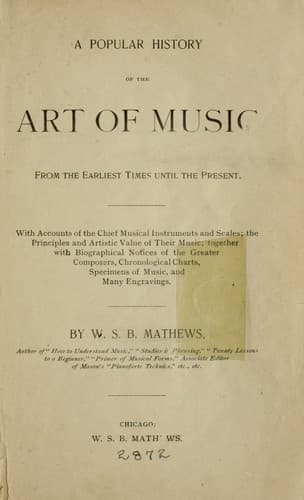
A Popular History of the Art of Music: From the Earliest Times Until the PresentMathews, W. S. B. (William Smythe Babcock)
History
A Popular History of the Art of Music: From the Earliest Times Until the Present
Mathews, W. S. B. (William Smythe Babcock)
Music -- History and criticism
dramatic _arioso_ of German opera during the nineteenth century.
Haendel came nearer to this type of musical formation, for example, in
the "Messiah," at the recitative describing the appearance of the
angels to the shepherds, where, after a phrase of unaccompanied
recitative, the appearance of the angels is signified by an
accompanied and measured strain, "And lo, the angel of the Lord came
upon them."
This development of opera in the nineteenth century has been carried
forward by the successive efforts of a considerable number of masters,
among whom the three most important are Weber, Meyerbeer and Wagner,
each of whom created a type of opera peculiar to himself, and left
something as an addition to the permanent stock of musical dramatic
ideas.
[Illustration: Fig. 76.
CARL MARIA VON WEBER.]
II.
Carl Maria von Weber (1786-1826) was the son of a very musical family.
He was born at Eutin, and fulfilled his father's desire, which had
always been to have a child who should correspond to the youthful
promise of Mozart. The father was an actor, and the director of a
traveling troupe, largely composed of his own children by a former
marriage. This mode of life continued for a number of years, while the
future master was quite small. In 1794 Carl Maria's mother was engaged
as a singer at the theater at Weimar, under Goethe's direction.
Presently, however, the boy became a pupil of Heuschkel, an eminent
oboeist, a solid pianist and organist, and a good composer. Under his
careful direction Weber developed a technique which very soon passed
far beyond anything that had previously been seen. Still later he
became a pupil of Michael Haydn, a brother of Joseph. As early as 1800
the boy gave concerts in Leipsic and other towns in central Germany.
At this time an opera book was given him, "_Das Wald Maedchen_," and
the opera was composed and produced in November. Five years later it
was highly appreciated at Vienna, and was performed also at Prague and
St. Petersburg. Young Weber was of a most active mind, and interested
himself in all questions of art. In 1803 he made the acquaintance of
the famous Abbe Vogler, and became his pupil. Vogler commissioned him
to prepare the piano score of a new opera of his. He still continued
his practice as pianist, but when he lacked some months of being
eighteen years of age he was made director of the music of the theater
at Breslau. This was his first acquaintance with practical life as a
musician. He showed great talent for direction and organization, and
here he composed his first serious opera "_Rubezahl_" (1806). His
next position was at Stuttgart, where he became musical director in
1807. After composing several short pieces, he led a somewhat
irregular life for several years, concerting as a pianist, writing
articles for the papers, at which he was very talented, beginning a
musical novel, and at length, in 1810, producing his opera "_Abou
Hassan_." Then followed about three years of roving life as a concert
Public-domain text, read in full here on John Shaqi.
Reviews
Reviews
No reviews yet
Be the first to share your thoughts on this work.
Elsewhere in the archive
Join the Discussion
Join the discussion
Sign in to leave a comment or review.
Sign InorCreate an account