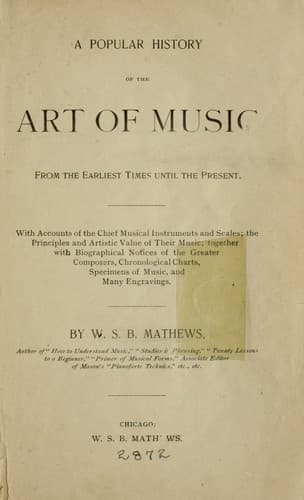
A Popular History of the Art of Music: From the Earliest Times Until the PresentMathews, W. S. B. (William Smythe Babcock)
History
A Popular History of the Art of Music: From the Earliest Times Until the Present
Mathews, W. S. B. (William Smythe Babcock)
Music -- History and criticism
Soon after his removal to Zurich, he commenced to compose the libretto
of the "Nibelung's Ring." This work was founded on the famous old
German poem, "_Die Nibelungen Lied_," but with very important
modifications of Wagner's own. It is divided into four works. In the
first, "_Das Rheingold_," the gold of the Rhine, is stolen, and a
curse is laid upon it. The second opera of the series is "_Die
Walkuere_." In this work the remarkable character of Brunhilde is the
central figure. She is one of the Wish-maidens of Odin, whose duty it
was to conduct the souls of slain heroes to Walhalla, the dwelling
place of the gods. The entire conception of this character is unique,
and still more unique in the musical way in which it is worked out. We
find in this work also the mother and father of Siegfried, and the
opera closes when Brunhilde is thrown into the magic slumber with the
fire around her. The third opera of the series is that of Siegfried,
the half-divine, half-human hero, who knows no fear--who slays the
dragon that captures the gold of the Rhine--awakens Brunhilde from her
magic sleep, etc. The fourth opera is called "The Twilight of the
Gods," or "The Death of Siegfried." I will not consume space by
describing this poem in detail, since this material is easily
accessible in every encyclopedia. I have already treated it at
considerable length in the second volume of my "How to Understand
Music." These works are especially remarkable upon a musical side. The
opera of the "Rhinegold" is a little monotonous, but the orchestral
score contains many points of beauty, and "The Valkyrie" is beautiful
throughout, conceived in a very masterly and poetic vein; the
instrumentation, also, is extremely noble and beautiful. In the whole
of these two works there is scarcely a single piece which can be
played apart from the rest as a concert number. The drama moves
straight on from one thing to another. There are no melodies of the
conventional type, and the music is closely woven together, like the
effects of an April day, with storms, sunshine and shadows following
each other without any perceptible break. So great has been the
advance in musical taste since these were first composed, that "The
Ride of the Valkyries," a famous descriptive piece for orchestra,
forming the prelude of the second act, has been played in all parts of
the world, as also the "Magic Fire Scene," which closes the opera.
These are given over and over again by Thomas, and arrangements of
them are often played at the piano. Directly he had finished "_Die
Walkuere_," Wagner sent it to Liszt, and a letter with it, in which he
modestly admitted that he thought it was very fine, or words to that
effect. Liszt, on his part, was delighted with it. He wrote a most
beautiful and noble letter to Wagner about it, and a little later he
speaks of Hans von Buelow having been with him, when he could not
refrain from giving him "a sight of Walhalla." So he brought out the
Public-domain text, read in full here on John Shaqi.
Reviews
Reviews
No reviews yet
Be the first to share your thoughts on this work.
Elsewhere in the archive
Join the Discussion
Join the discussion
Sign in to leave a comment or review.
Sign InorCreate an account