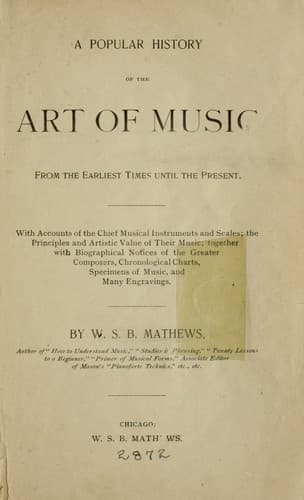
A Popular History of the Art of Music: From the Earliest Times Until the PresentMathews, W. S. B. (William Smythe Babcock)
History
A Popular History of the Art of Music: From the Earliest Times Until the Present
Mathews, W. S. B. (William Smythe Babcock)
Music -- History and criticism
score, and he said that Hans pounded at the piano, and he himself
hummed and howled as well as he could, and they had a great time over
it.
Wagner then set to work on the opera of "_Siegfried_," which
interested him very much indeed. This character also is a genuine
conception of Wagner's. The wild forest boy who knows no fear, who has
the most marvelous strength, is described in music as wild and
powerful as himself. When Sieglinde, Siegfried's mother, was married,
an old man appeared at the wedding with an ashen staff, his hat brim
drooping over one eye, and in the midst of the festivities he drew a
mighty sword and with a great blow thrust it into the stem of the ash
tree which grew in the center of the house, saying that it was the
sword of a hero, and that whoever was strong enough to draw it should
wield it in the service of gods. All the strong men tugged at this
weapon, but none were able to draw it. When Siegmund, Siegfried's
father, comes there, he draws the weapon amid a splendid burst of
music. This sword is broken on Wotan's spear, but the pieces are saved
for Siegfried, and one of the great scenes in the opera of
"_Siegfried_" is where he welds anew the broken sword, and at the end
cleaves the anvil with one mighty stroke. The opera of "_Siegfried_"
closes with the awakening of Brunhilde, and a splendid duet with
Siegfried.
The composition of this work was interrupted at the end of the second
act, and here we come to one of the most curious circumstances in
Wagner's career. He says that he felt it necessary to stop now and
write a practical opera for the stage as it then was, in order to
re-establish his connection with the German theater, for he did not
believe that these works would be performed in his own time.
Accordingly he wrote "_Die Meistersinger_," and the opera of "Tristan
and Isolde." They were finished in 1865, and Hans von Buelow, who was
then director of the opera at Munich, took them both for rehearsal;
they had there about 160 rehearsals of "Tristan and Isolde"--but gave
it up as impossible, the singers forgetting from one day to another
the music they had learned the previous day. The other work, "_Die
Meistersinger_," fared better. They had sixty-six rehearsals, and
finally brought it to a dress rehearsal, which was as far as they got
toward performing it. Nothing shows the increased growth that Wagner
had made, as well as his unconsciousness of this growth, like this
experience of his operas at Munich, under so enterprising and able a
director as Hans von Buelow--who was undoubtedly the most competent man
in Germany, as well as the most courageous, for the task of producing
this kind of work. Although these operas were not successful at the
time, "_Die Meistersinger_" has since become highly appreciated upon
large stages, and it is in my opinion the most beautiful opera that
has ever been written. The music throughout is in a noble and
dignified strain, with melodies beautiful and highly finished, almost
Public-domain text, read in full here on John Shaqi.
Reviews
Reviews
No reviews yet
Be the first to share your thoughts on this work.
Elsewhere in the archive
Join the Discussion
Join the discussion
Sign in to leave a comment or review.
Sign InorCreate an account