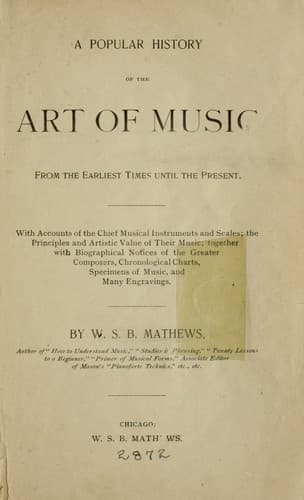
A Popular History of the Art of Music: From the Earliest Times Until the PresentMathews, W. S. B. (William Smythe Babcock)
History
A Popular History of the Art of Music: From the Earliest Times Until the Present
Mathews, W. S. B. (William Smythe Babcock)
Music -- History and criticism
Wagner left a large number of pamphlets and treatises, which are
likely to remain among the classics of musical literature. The most
important is his "Opera and Drama," written in 1851. This is a full
discussion, in singularly vigorous and clear language, of the entire
nature of opera as poetically conceived and as practically carried out
by the previous masters, and as proposed to be carried out by Wagner
himself. Many of Wagner's writings have now been translated into
English. His opera texts are highly esteemed by his admirers, and
respected by all. As a poet the general opinion seems to be that he
was given to magnificent phraseology rather than to delicacy of fancy
or humor. He is most at home with the grand, the gigantic, the
superhuman; and in nearly all that he writes the primeval undertone of
the minor makes itself felt.
It is entirely uncertain whether opera will continue to follow the
lines he laid down, with the same severity, but there can be no
question that his influence upon the course of art will be very great.
In musical discourse, especially in the harmonic side of it, Wagner
has made very great variations from the practices of his predecessors,
even the most free of the instrumental writers--Schumann. His
modulations are carried into more remote keys, and the tempered scale
is taken as a finality of our tonal system. All the keys are brought
near, as he treats them, and in any key any chord whatever can be
introduced without effecting a modulation, provided it be so managed
that the sense of tonality is not unsettled.
Personally Wagner was rather small, very fastidious in his attire and
surroundings. In 1869 Mme. Cosima, daughter of Liszt, and wife of Von
Buelow, left him and became the wife of Wagner. During the last ten
years of his life they had an elegant residence at Bayreuth, where
Mme. Wagner still has her home. Wagner died in Venice, whither he had
gone for the mild climate. No musician in the entire history of art
has occupied the attention of the whole contemporaneous world to
anything like the same degree as did Richard Wagner, from the
performance of "_Lohengrin_," in 1850, until his death in 1883.
CHAPTER XXXV.
VIRTUOSITY IN THE NINETEENTH CENTURY; PAGANINI; BERLIOZ; CHOPIN;
LISZT.
I.
Strictly speaking, there was no break in the continuity of art
development represented in the virtuoso appearances recorded in
Chapter XXX, and those with which we have presently to deal. In point
of chronology, many of those recorded in the present chapter were
contemporaneous with some of those in the former. Nevertheless, the
artists with whom we are now concerned represent principles more
decidedly belonging to the romantic, and hence to the nineteenth
century, than did those whose operations have already been discussed
as part of the record of the eighteenth. This is seen in the quality
and the novelty of their playing, and still more in the influence
which they exercised upon the musicians who came after.
Public-domain text, read in full here on John Shaqi.
Reviews
Reviews
No reviews yet
Be the first to share your thoughts on this work.
Elsewhere in the archive
Join the Discussion
Join the discussion
Sign in to leave a comment or review.
Sign InorCreate an account