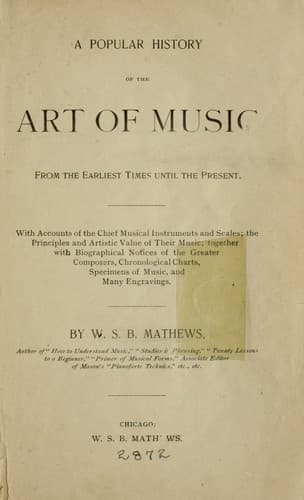
A Popular History of the Art of Music: From the Earliest Times Until the PresentMathews, W. S. B. (William Smythe Babcock)
History
A Popular History of the Art of Music: From the Earliest Times Until the Present
Mathews, W. S. B. (William Smythe Babcock)
Music -- History and criticism
By the time he had completed this work, Wagner had conceived the idea
of a national theater, to be completed regardless of cost, and with
appointments permitting it to produce great works in a faultless
manner. At first he thought of building it at Munich, but the Munich
public proving fickle, he resolved to build it in an inland town,
where all his audience would be in the attitude of pilgrims, who would
have come from a distance to hear a great work with proper
surroundings. The sum required to complete this was about $500,000. It
is sufficient compliment to Wagner's ability to say that he secured
it, King Louis, of Bavaria, having contributed more than $100,000.
Large sums also were sent in by Wagner societies all over the world.
The house was completed at Bayreuth. It was a little theater holding
about 1,500 people, with a magnificent stage, which at that time was
far in advance of any other, but has since been surpassed by many,
notably by that of the Auditorium, in Chicago. Here he proposed to
have what he called a stage festival--the singers to contribute their
services gratuitously, the honor of being selected for this place, and
the advantage of the experience, being regarded as ample compensation.
The orchestra, likewise, in great part was to be composed of
virtuosi--also to play without pay. All these expectations were
realized. Leading the violins for several years was the famous
virtuoso, Wilhelmj, and the singers of the Bayreuth festival were the
best that the German stage possessed. The festival is now carried out
upon a more rational basis, the singers receiving something for their
services. Wagner completed his achievements by the opera of
"_Parsifal_"--a work nearly related to "_Lohengrin_"--in some respects
more beautiful. This is entirely like church music, and the whole
effect of the performance at Bayreuth,--for it has never been given
elsewhere--is noble and beautiful. It leaves an impression like a
church service.
The peculiarities of Wagner's operas are many. The plays, from a
poetic side, are in the vein of magic; irresistible causes work
together for irresistible ends. They are somber and primeval, like the
voice of the forest. The music fits the poem exactly, without making
any attempt at being beautiful on its own account. It is extremely
elaborate, and richly scored for orchestra, and full of beautiful
science--not intended to be recognized as such by the average hearer.
From a dramatic point of view the works are very consistent, and the
stage effects are of a remarkable kind. Wagner was fortunate enough to
make the acquaintance of a mechanic able to carry out some of his most
impracticable suggestions.
Public-domain text, read in full here on John Shaqi.
Reviews
Reviews
No reviews yet
Be the first to share your thoughts on this work.
Elsewhere in the archive
Join the Discussion
Join the discussion
Sign in to leave a comment or review.
Sign InorCreate an account