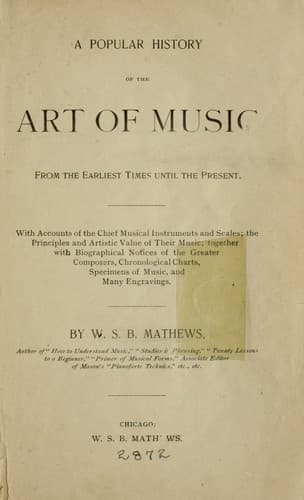
A Popular History of the Art of Music: From the Earliest Times Until the PresentMathews, W. S. B. (William Smythe Babcock)
History
A Popular History of the Art of Music: From the Earliest Times Until the Present
Mathews, W. S. B. (William Smythe Babcock)
Music -- History and criticism
Upon two composers of this century Paganini's influence was extremely
powerful. Schumann took his departure from the Paganini caprices,
seeking to perform upon the piano the same kind of effect which
Paganini had obtained from the violin, or to discover others
equivalent to them. And Liszt set himself to do upon the piano the
same kind of impossibilities which Paganini had performed upon the
violin. Both these masters accomplished more than they planned for.
Schumann enriched the current of musical discourse by his experiments
having their departure from Paganini, thereby accomplishing something
which Paganini did not; for while the great violinist's works are of
astonishing value for the violin, they are not particularly
significant as tone-poetry. They are pleasing and sensational, and at
times passionate, show pieces for the virtuoso.
II.
Hector Berlioz (1803-1869), for whose genius Paganini had such
admiration, was perhaps the most remarkable French personality in
music during the nineteenth century, and one of the most commanding in
the whole world of music. He was born at Grenoble, in the south of
France. His father, a physician, intended that the son should follow
his own profession, but when the young Berlioz was sent to Paris to
study medicine, at the age of eighteen, music proved too strong for
him, and he entered the Conservatory as a pupil of Lesueur. His
parents were so incensed by this course that the paternal supplies
were cut off, and the young enthusiast was driven to the expedient of
earning a scanty living by singing in the opera chorus at an obscure
theater, _La Gymnase Dramatique_. The daring originality of the young
musician, and his habit of regarding every rule as open to question,
rendered him anything but a favorite with Cherubini, the director of
the Conservatory, and it was only after several trials that he carried
off the prize for composition. The second instance of this kind
occurred in 1830, the piece being a dramatic cantata "_Sardanapole_,"
which gained him the prize of Rome, carrying with it a pension
sufficient to maintain the winner during three years in Italy.
Public-domain text, read in full here on John Shaqi.
Reviews
Reviews
No reviews yet
Be the first to share your thoughts on this work.
Elsewhere in the archive
Join the Discussion
Join the discussion
Sign in to leave a comment or review.
Sign InorCreate an account