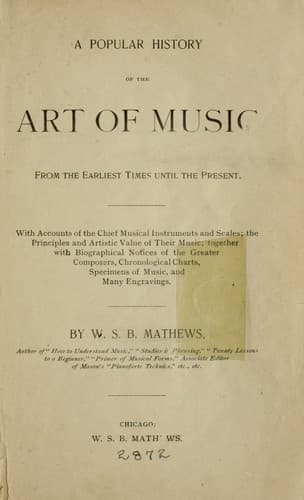
A Popular History of the Art of Music: From the Earliest Times Until the PresentMathews, W. S. B. (William Smythe Babcock)
History
A Popular History of the Art of Music: From the Earliest Times Until the Present
Mathews, W. S. B. (William Smythe Babcock)
Music -- History and criticism
On his return to Paris, he found it extremely difficult to secure a
living by his compositions, their originality and the scale upon which
he carried them out, placing them outside the conventional markets for
new musical works designed for public performance. In this strait he
took to writing for the press, in the _Journal des Debats_, for which
his talent was little, if any, less marked than for musical
production upon the largest scale. As a writer, he was keen,
sarcastic, bright and sympathetic. A man of the world, and at the same
time an artist, he touched everything with the characteristic
lightness and raciness of the born _feuilletonist_. Very soon (in
1834), he produced his symphony "_Harold en Italie_," which Paganini
so much admired that he presented Berlioz with the very liberal, even
princely _douceur_ of 20,000 francs ($4,000). Meanwhile Berlioz was
unable to secure recognition in Paris. His compositions were regarded
as extravagant and fantastic, and Parisians were curiously surprised
at the reception the composer met with in Germany, when he traveled
there in 1842 and 1843, and again in 1852, bringing out his works. The
Germans were by no means unanimous regarding his merits. Mendelssohn,
who found Berlioz most interesting as a man, had no admiration for his
music. To him it appeared crazy and unbeautiful. The sole recognition
which Berlioz had in France was the librarianship of the
_Conservatoire_, with a modest salary, and the Cross of the Legion of
Honor. In spite of the small esteem in which this clever master was
held by his countrymen during his life, he produced a succession of
remarkable works, without which the art of music would have missed
some of its brightest pages. Among these we may mention his dramatic
legend of "The Damnation of Faust," for solos, chorus and orchestra,
which marks one of the highest points reached by program music. This
great work is now generally accepted as one of the best of the
romantic productions, and the orchestral pieces in it have become part
of the standard repertory of orchestras everywhere.
Public-domain text, read in full here on John Shaqi.
Reviews
Reviews
No reviews yet
Be the first to share your thoughts on this work.
Elsewhere in the archive
Join the Discussion
Join the discussion
Sign in to leave a comment or review.
Sign InorCreate an account