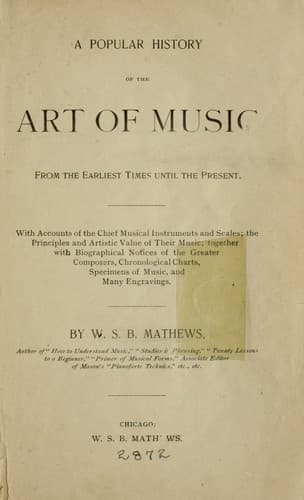
A Popular History of the Art of Music: From the Earliest Times Until the PresentMathews, W. S. B. (William Smythe Babcock)
History
A Popular History of the Art of Music: From the Earliest Times Until the Present
Mathews, W. S. B. (William Smythe Babcock)
Music -- History and criticism
Berlioz was above all the composer of the grandiose, the magnificent.
This appears in his earliest works. In 1837 he composed his Requiem,
for the funeral obsequies of General Damremont. This work is of
unprecedented proportions. It is scored for chorus, solos and
orchestra, the latter occasionally of extraordinary appointment. In
the "_Tuba Mirum_," for example, he desires full chorus of strings,
and four choirs of wood-wind and brass. The wood-wind consists of
twelve horns, eight oboes, and four clarinets, two piccolos and four
flutes. The brass is disposed in four choirs as follows, each at one
of the corners of the stage; the first consists of four trumpets, four
tenor trombones and two tubas; the second of four trumpets and four
tenor trombones; the third the same; the fourth of four trumpets, four
tenor trombones and four ophicleides. The bewildering answers of these
four choirs of brass give place at the words "Hear the awful trumpet
sounding," to a single bass voice, accompanied by sixteen kettle
drums, tuned to a chord. A movement of similar sonority is the "_Rex
Tremendae Majestatis_." At other times the work is very melodious. It
is indeed singular that a young composer should commence his career
with a piece so daring. But to Berlioz's credit it must be said he
never makes a mistake in his calculations of effect. When he desires
contrast and blending effect of different masses, these results always
follow whenever his work is performed according to his directions.
Public-domain text, read in full here on John Shaqi.
Reviews
Reviews
No reviews yet
Be the first to share your thoughts on this work.
Elsewhere in the archive
Join the Discussion
Join the discussion
Sign in to leave a comment or review.
Sign InorCreate an account