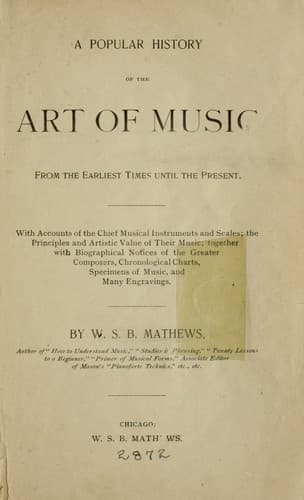
A Popular History of the Art of Music: From the Earliest Times Until the PresentMathews, W. S. B. (William Smythe Babcock)
History
A Popular History of the Art of Music: From the Earliest Times Until the Present
Mathews, W. S. B. (William Smythe Babcock)
Music -- History and criticism
To return to Thalberg.--In 1856 he visited America, where his success
was the same as in all other parts of the world. Having accumulated a
fortune, he retired from active life, and bought an estate near
Naples, where he spent the remainder of his life. There were reasons
of a purely external and conventional kind why the playing of Thalberg
should have attracted more attention, or at least been more admired,
than that of Liszt, in Paris and in aristocratic circles everywhere.
His manner was the perfection of quiet. Whatever the difficulty of the
passages upon which he was engaged, he remained perfectly quiet,
sitting upright, modestly, without a single unnecessary motion.
Moreover, the general character of his passages, which progressed
fluently upward or downward by degrees, instead of taking violent
leaps from one part of the keyboard to another, permitted him to
maintain this elegant quiet with less restriction than would have been
possible in such works, for instance, as the great concert fantasias
of Liszt. It is to be noticed, further, that the peculiar sonority of
Thalberg's playing depended upon the improvements in the pianoforte,
made just before his appearance and during his career. His method of
playing the melody, moreover, while perhaps not distinctly so
recognized by him, employed a noticeable element of the arm touch,
while his passage work was a ringer movement of the lightest and most
facile description. His chords, also, were often struck with a finger
touch, and he was perhaps the originator of the peculiar effect
produced by touching a chord with the fingers only, but rebounding
from the keys with the whole arm to the elbow. A chord thus played has
the delicacy peculiar to finger work, but in the removal from the keys
the muscles of the arm are called into action in such a way that the
finger stroke is intensified to a degree somewhat depending upon the
height to which the rebound is carried.
IV.
Public-domain text, read in full here on John Shaqi.
Reviews
Reviews
No reviews yet
Be the first to share your thoughts on this work.
Elsewhere in the archive
Join the Discussion
Join the discussion
Sign in to leave a comment or review.
Sign InorCreate an account