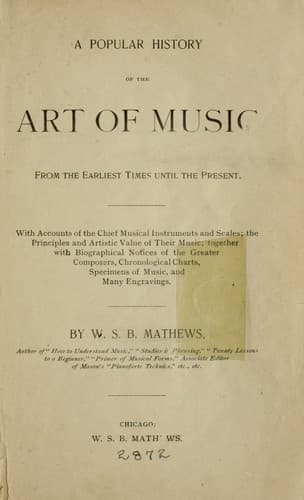
A Popular History of the Art of Music: From the Earliest Times Until the PresentMathews, W. S. B. (William Smythe Babcock)
History
A Popular History of the Art of Music: From the Earliest Times Until the Present
Mathews, W. S. B. (William Smythe Babcock)
Music -- History and criticism
Francois Frederic Chopin (1809-1849) was one of the most remarkable
composers of this epoch, and in some respects one of the most
precocious musical geniuses of whom we have any record. He was born at
Zela-Zowa Wola, a village six miles from Warsaw, in Poland, the son of
a French merchant living there, who had married a Polish lady. Later,
in consequence of financial reverses, his father became a teacher in
the university. The boy, Francois, was brought up amid refined and
pleasant surroundings, and his education was carefully looked to.
Although rather delicate in appearance, he was healthy and full of
spirits. His precocity upon the piano was such that at the age of nine
he played a concerto in public with great success, from which time
forward he made many appearances in his native city. He early began to
compose, and by the time he was thirteen or fourteen, had undertaken a
number of works of considerable magnitude. After having received the
best instruction which his native city afforded, he started out, at
the age of nineteen, for a visit to Vienna, where he appeared in two
concerts, and to his own surprise was pronounced one of the greatest
virtuosi of the day. This, however, is not the point of his precocity.
When he started upon his tour to Vienna, he had with him certain
manuscripts, which he had composed. His Opus 2 consisted of variations
upon Mozart's air, "_La ci Darem la Mano_," of which later Schumann
wrote such a glowing account in his paper at Leipsic. These variations
were enormously difficult, and in a wholly novel style. There were
several mazurkas, the three nocturnes, Opus 9, of which the extremely
popular one in E flat stands second; the twelve studies, Opus 10,
dedicated to Franz Liszt, and a concerto in F minor, and all or nearly
all of that in E minor. These were the work of a boy then only
nineteen, the pupil of a comparatively unknown provincial teacher.
When we examine these works more minutely, our astonishment increases,
for they represent an entirely new school of piano playing. New
effects, new management of the hands, new passages, beautiful melody,
exquisitely modulated harmonies--in short, a new world in piano
playing was here opened. So difficult and so strange were these works,
that for nearly a generation the more difficult ones of them were a
sealed book to amateur pianists, and even virtuosi like Moscheles
declare that they could never get their fingers reliably through them.
[Illustration: Fig. 82.
FREDERIC CHOPIN.]
Public-domain text, read in full here on John Shaqi.
Reviews
Reviews
No reviews yet
Be the first to share your thoughts on this work.
Elsewhere in the archive
Join the Discussion
Join the discussion
Sign in to leave a comment or review.
Sign InorCreate an account