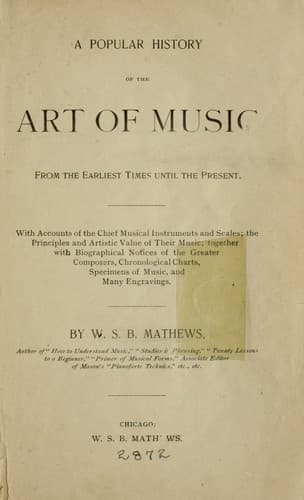
A Popular History of the Art of Music: From the Earliest Times Until the PresentMathews, W. S. B. (William Smythe Babcock)
History
A Popular History of the Art of Music: From the Earliest Times Until the Present
Mathews, W. S. B. (William Smythe Babcock)
Music -- History and criticism
Chopin's place in the Pantheon of the romantic school is that of the
popularizer of pianoforte sentiment. His compositions, by whatever
name they may be called, are essentially lyric pieces, songs, ballads
and fanciful stories in rhyme. The subjects are frequently tender or
sad, sometimes morbid--in short, Byronic. The treatment is always
graceful and high-bred, and the contrasts strong. The melodies are
embroidered with a peculiar kind of _fioratura_, which he invented
himself, founded upon the Italian embellishment of that kind--a
delicate efflorescence of melody, which, when perfectly done, is
extremely pleasing. The names applied to the different compositions
such as Ballade, Scherzo, Prelude, Rondo, Sonata, Impromptu, have only
a remote reference to the nature of the piece. Occasionally the entire
composition is morbid and unsatisfactory to a degree. These belong to
the later period of his life, when he was in poor health. He is a
woman's composer. In his strongest moments there is always an
effeminate element. In this respect he is exactly opposite to Schumann
and Beethoven, whose works, however delicate and refined, have always
a manly strength. Chopin made the most important modifications in the
current way of treating the piano. In this part of his activity he
seemed to realize the possibilities of the instrument, in the same way
that Paganini had recognized those of the violin. His passages, while
based upon those of Hummel, nevertheless produced effects of which
Hummel was totally incapable. Chopin is the originator of the extended
_arpeggio_ chord, of the chromatic sequences of the diminished
sevenths with passing notes, and cadenza forms derived from them. He
is thoroughly French in his views of "changing notes," as, for
instance, in the accompaniment to the impromptu in A flat, Opus 29.
His influence upon the general progress of musical development is to
be traced in the works of Liszt, especially in the later pianoforte
works, and in a large number of less gifted imitators, like Doehler.
V.
Public-domain text, read in full here on John Shaqi.
Reviews
Reviews
No reviews yet
Be the first to share your thoughts on this work.
Elsewhere in the archive
Join the Discussion
Join the discussion
Sign in to leave a comment or review.
Sign InorCreate an account