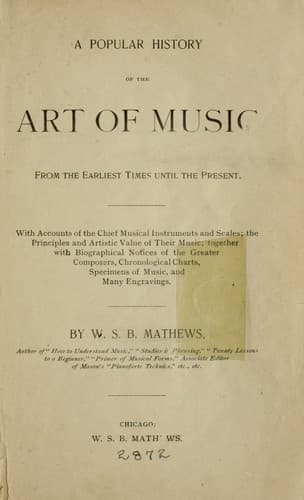
A Popular History of the Art of Music: From the Earliest Times Until the PresentMathews, W. S. B. (William Smythe Babcock)
History
A Popular History of the Art of Music: From the Earliest Times Until the Present
Mathews, W. S. B. (William Smythe Babcock)
Music -- History and criticism
Aside from Wagner, the most remarkable figure of this century is that
of Franz Liszt, who was born at Raiding, in Hungary, 1811, and died at
Bayreuth, 1886. His father, Adam Liszt, was an official in the
imperial service, and a musical amateur, capable of instructing his
son in piano playing. At the age of nine he made his first public
appearance, with so much success that several noblemen guaranteed the
money to enable him to pursue his studies for six years in Vienna.
Here he became a pupil of Czerny, Salieri and Randhartinger. He made
the acquaintance of Schubert, and upon one occasion played before
Beethoven, who kissed him, with the prophecy that he would make his
mark. His first appearance as a composer was in a set of variations on
a waltz by Diabelli, the same for which Beethoven wrote the
thirty-three variations, Opus 120. Liszt's variation was the
twenty-fourth in the set to which Beethoven did not contribute. It was
published in 1823, when he was twelve years old. The same year he went
to Paris, his father hoping to enter him at the Conservatory, in spite
of his foreign origin; but Cherubini refused to receive him, so he
studied with other composers. His operetta of "_Don Sanche_" was
performed at the _Academie Royale_ in 1825, and was well received. At
this time he was in the height of his youthful success in Paris,
tall, slender, with long hair and a most free and engaging
countenance, with ready wit and unbounded tact. He performed marvels
upon the piano, such as no one else could attempt. His repertory at
this time seems to have consisted of pieces of the old school. In 1827
he lost his father, and being thrown upon his own resources, he began
his concert tour. He appeared in London in 1827, his piece being the
Hummel concerto. Three years later he played in London again, his
number being the Weber _Concertstueck_.
Public-domain text, read in full here on John Shaqi.
Reviews
Reviews
No reviews yet
Be the first to share your thoughts on this work.
Elsewhere in the archive
Join the Discussion
Join the discussion
Sign in to leave a comment or review.
Sign InorCreate an account