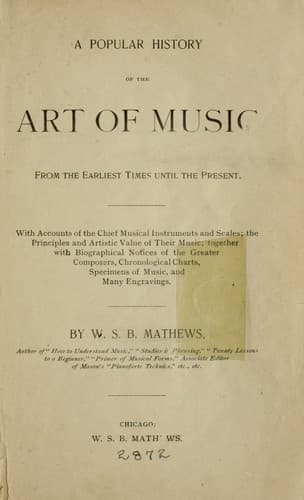
A Popular History of the Art of Music: From the Earliest Times Until the PresentMathews, W. S. B. (William Smythe Babcock)
History
A Popular History of the Art of Music: From the Earliest Times Until the Present
Mathews, W. S. B. (William Smythe Babcock)
Music -- History and criticism
There was something weird and magnetic about his playing. He was very
tall, about six feet two inches, slender, with piercing eyes, very
long arms, but small hands; he played without notes, and amid the most
frightful difficulties of execution kept his eyes fixed upon this,
that or the other person in the audience. He moved about at the piano
very much in the exciting passages, not, apparently, on account of the
difficulty of overcoming technical obstacles, but simply from innate
fire and excitement. As for technical difficulties, they did not
exist. Everything that the piano contained seemed to be at his
service, and the only regret was that the instrument was not better
able to respond to his demand. In the _fortissimo_ passages his tone
was immense, and his _pianissimos_ were the most delicate whispers. In
these his fingers glided over the keys with inconceivable lightness
and speed, and the tone fell upon the ear with a delicate tracery with
which no particular was lost by reason of speed or lightness. This
wonderful control of the instrument stood him in equal stead with his
own compositions, especially adapted to his own style of playing; or
with the works of the old school, which he transfigured as they had
never been played before; or the last sonatas of Beethoven, which at
that time were a sealed book to most musicians. These, indeed, he did
not play in public, but in private. The essential novelties of the
Liszt technique were the _bravura_ cadenzas. The other sensational
features, such as carrying the melody in the middle range of the piano
with surrounding embroidery, the rapid runs and the extravagant
climaxes, were all more or less common to the three representative
virtuoso piano writers of this epoch--Liszt, Chopin and Thalberg.
A careful study of all the circumstances and influences surrounding
Liszt at the time, leads to the conclusion that his ideas of the
possibilities of the pianoforte were matured very gradually, not
reaching their complete expression in the operatic fantasias before
about 1834 or 1835. His early appearances were in pieces of the old
school, and there is nothing more to be found in contemporary accounts
of his playing than admiration for its superior fire and delicacy.
Upon the appearance of Paganini, however, this was changed. The
temporary eclipse, which this brilliant apparition made of the rising
Liszt, led him to new studies in original directions. Thus arose the
transcriptions of the Paganini caprices in 1832, and the composition
of his own "Studies for Transcendent Execution," in the same or the
following year. Farther sensational improvements were probably the
result of the Thalberg contest in Paris during 1835.
Public-domain text, read in full here on John Shaqi.
Reviews
Reviews
No reviews yet
Be the first to share your thoughts on this work.
Elsewhere in the archive
Join the Discussion
Join the discussion
Sign in to leave a comment or review.
Sign InorCreate an account