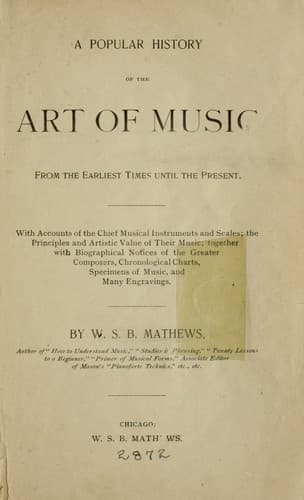
A Popular History of the Art of Music: From the Earliest Times Until the PresentMathews, W. S. B. (William Smythe Babcock)
History
A Popular History of the Art of Music: From the Earliest Times Until the Present
Mathews, W. S. B. (William Smythe Babcock)
Music -- History and criticism
In "Elijah" and in the first part of "St. Paul" Mendelssohn made an
addition to the world's stock of oratorios scarcely second to any
other works, excepting Haendel's "Messiah." "Elijah," in particular,
had the advantage of an extremely dramatic and picturesque story, and
a text well selected from the Scriptures. There are many moments in
this work of rare and exquisite beauty. The choruses when
contrapuntally developed, have themes somewhat too short, whereby the
effect of the words is lost in the intermingling of voices coming in
at later moments, but there are other parts of the work which are
extremely beautiful. There is a lovely chorus, "He Watching over
Israel," in which the gentle Mendelssohnian melody is accompanied by
soft triplets in the strings, whereby a most delightfully light and
_spirituelle_ effect is produced. Near the end of the work there is a
very graphic recitative to the words, "And One Cherub Cried to
Another"; then a soprano voice with grand phrase sings "Holy, Holy Is
God, the Lord," three other soprano voices joining in the last words.
These are very lightly accompanied. Immediately thereupon, the entire
chorus, orchestra and organ, with the utmost power, come in with the
same melody, "Holy, Holy Is God, the Lord." This antiphon between the
full chorus and the female quartette continues in varying style
throughout the chorus, and the result is thrilling in the extreme.
Extremely dramatic, also, is the great chorus "Thanks Be to God, for
He Laveth the Thirsty Land." There are many solo numbers in the work,
all of them remarkable for the care with which the text is treated,
and the clearness with which the musical utterance expresses the
words. The famous tenor song, "If with All Your Hearts Ye Truly Seek
Him," the alto song, "Oh Rest in the Lord," the angel trio, "Lift
Thine Eyes," the great soprano song, "Hear Ye Israel," and the bass
aria, "It Is Enough," and especially the prayer of Elijah, "Lord God
of Abraham, Isaac and Israel," are scarcely surpassed in the entire
range of oratorio music. There is very remarkable instrumentation,
also in the scenes on Mt. Carmel, and especially at the series of
choruses where "God, the Lord, Passed By."
Public-domain text, read in full here on John Shaqi.
Reviews
Reviews
No reviews yet
Be the first to share your thoughts on this work.
Elsewhere in the archive
Join the Discussion
Join the discussion
Sign in to leave a comment or review.
Sign InorCreate an account