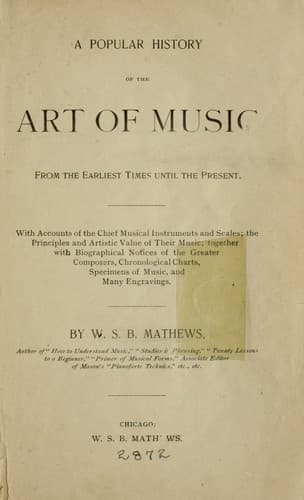
A Popular History of the Art of Music: From the Earliest Times Until the PresentMathews, W. S. B. (William Smythe Babcock)
History
A Popular History of the Art of Music: From the Earliest Times Until the Present
Mathews, W. S. B. (William Smythe Babcock)
Music -- History and criticism
During his life, Mendelssohn was very highly esteemed as a composer of
orchestral music, symphonies and overtures. While his works in this
department contain many beauties, and are carried out with elegant
clearness of form, and with that refinement and taste which
characterized everything which Mendelssohn did, they have not
maintained their reputation at the high level where it formerly stood.
It was Mendelssohn's fortune to be one of the masters instrumental in
introducing the romantic school; but upon principle and education he
was classical in his taste and instincts, and while his works had a
very important use in cultivating an appetite for novelty, whereby the
other masters of the romantic school profited later, he went so short
a distance in the new path that the march of events has since left him
somewhat behind.
II.
If it were asked to name the two masters most representative of the
nineteenth century, one could scarcely go amiss, the names of Robert
Schumann and Richard Wagner immediately occurring. Robert Schumann
(1810-1856), the son of a very intelligent book seller, was born at
Zwickau, in Saxony, and was intended for the law. He received lessons
in music at an early age, and his talent was unmistakable. When he was
about eleven he accompanied a performance of Frederick Schneider's
"_Weltgericht_." At home, with the aid of some musical companions he
got up performances of musical compositions, and had a small
orchestra. He entered at the Leipsic University as a student of law,
but devoted the most of his time to playing the piano, and to reading
Jean Paul, for whom he had a great fondness. He immediately attached
himself to the musical circles, entering himself as a pupil with
Wieck, the father of his future wife. A year later he transferred his
attendance to the University of Heidelberg, attracted thither by the
lectures of the famous teacher Thibaut, the same whose work upon the
"Purity of Musical Art," had only recently been published. Here, as in
Leipsic, his principal occupation was practicing upon the piano, which
he did to the extent of six or seven hours a day. Notwithstanding his
fondness for music, his mother was violently opposed to his entering
the musical profession, and as his father was now dead, her wishes
naturally had much weight. He had already commenced to write songs,
quite a number of which belong to the year 1830, when he was living in
Heidelberg.
Public-domain text, read in full here on John Shaqi.
Reviews
Reviews
No reviews yet
Be the first to share your thoughts on this work.
Elsewhere in the archive
Join the Discussion
Join the discussion
Sign in to leave a comment or review.
Sign InorCreate an account