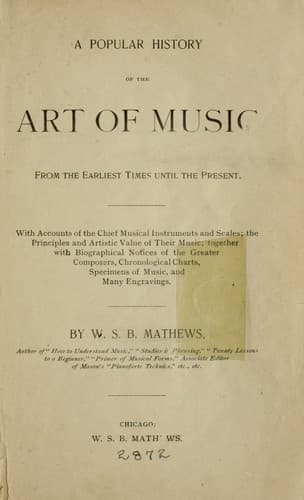
A Popular History of the Art of Music: From the Earliest Times Until the PresentMathews, W. S. B. (William Smythe Babcock)
History
A Popular History of the Art of Music: From the Earliest Times Until the Present
Mathews, W. S. B. (William Smythe Babcock)
Music -- History and criticism
for the accompaniment, and the constant use of the pedal for
promoting blending of tones, that the vague and poetic atmosphere of
this piece can be realized.
Schumann might also be credited with the invention of a new style of
composition, or of music thinking. The element of canonic imitation
occurs in his works in wholly new form. A single phrase or motive is
repeated through nearly an entire movement, in a thousand different
forms and transformations, so that the whole movement is made up from
this single germ; and yet with such mastery of rhythm and of harmony
as to conduct the thought to a powerful climax, without any impression
of monotony interfering with it. One can hardly go amiss in the large
works of Schumann for illustrations of this style of composition.
Take, for example, the Novelette in B minor, Opus 99; the Novelette in
E major, Opus 21, No. 7; the first of the "_Kreisleriana_," and many
other parts of the same work. This style I have elsewhere called the
"Thematic," as distinguished from the "Lyric," in which a flowing
melody is a distinctive trait. Beethoven, in a number of cases,
employs a style of thought development somewhat similar, but the
results accomplished are tamer than with Schumann. One of the most
striking examples is found in the finale of the sonata in D minor,
Opus 31, No. 2, and in the first movement of the sonata in C minor,
Opus 111. In this point of view Schumann appears as the predecessor of
Wagner, who almost certainly took his departure for thematic work from
Schumann.
If it were not for these numerous, highly poetic and masterly
compositions for pianoforte solo, and for the chamber pieces, the
symphonies and other large works, Schumann would have been entitled to
a very eminent place among composers by his songs alone. These are as
different as possible from those of previous writers, excepting
Schubert, and the voice itself is not always well considered in them;
but there are no other works in this department in which the poetic
sentiment is so thoroughly reproduced in the music as Schumann has
done it in his "Woman's Love and Life," and in "Poet's Love," and in
many single songs of other sets, "The Spring Night" being a very
marked example. If the future should chance to produce a race of
poetic and intelligent singers, these songs will be found among the
most effective which the whole literature of music can show. Some of
them are already well and favorably known in all parts of the world.
Public-domain text, read in full here on John Shaqi.
Reviews
Reviews
No reviews yet
Be the first to share your thoughts on this work.
Elsewhere in the archive
Join the Discussion
Join the discussion
Sign in to leave a comment or review.
Sign InorCreate an account