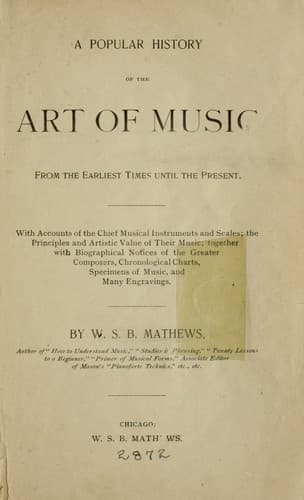
A Popular History of the Art of Music: From the Earliest Times Until the PresentMathews, W. S. B. (William Smythe Babcock)
History
A Popular History of the Art of Music: From the Earliest Times Until the Present
Mathews, W. S. B. (William Smythe Babcock)
Music -- History and criticism
The entire art of modern piano playing is indebted to Schumann for
some of its most impressive elements. He was fond of playing with the
dampers raised, and might well contest the honor with Liszt of having
originated the modern style of pedal legato as distinguished from the
finger legato of Chopin and all the early writers. He seems to have
discovered the touch which Mason called elastic; that made by shutting
the hand and at the same allowing the wrist to remain flexible. In
quite a number of his pieces this effect is very marked, as the first
number of "_Kreisleriana_," the first of the "Night Pieces," and
especially the fourth of these, where the chords are purposely spread
beyond the octave, in order to necessitate their being struck with the
finger and arm touch combined, in the same manner as that illustrated
on a larger scale in the eleventh study of Chopin's, Opus 10. Indeed,
if one were to attempt to characterize the Schumann technique by some
one of its more prominent features, the free use of the arm would be,
perhaps, the one best representing the depth and sonority of tone
required for these effects. But while Schumann demands broad, deep,
elastic tone color for the stronger moments in his work, there is no
other writer so desirous as he of the soft, full, mysterious tone
representing what he was fond of calling _Innigkeit_ ("inwardness").
There are many minor mannerisms which have been diligently cultivated
by later composers, the most prominent among them being perhaps what
might be called the accompaniment upon the off beat. In many of his
works Schumann occupies the middle ground of the piano with soft
chords which are felt rather than heard, and which always come in upon
the half beat or the quarter beat, and rarely or never upon the full
accented part of a measure. The differentiation of the melody from its
harmonic and rhythmic background is accomplished by this great master
in a beautiful manner. Take for instance, the romanze in F sharp, Opus
28, No. 2. The melody of the first strophe of this exquisite music
might have been written for Church. It is a duet for baritones, the
voices being represented by the thumbs of the player. Against this
melody in quarter notes and eighths, there is an accompaniment in
sixteenths, covering two octaves and a third, the entire effect being
soft and distant. In the second strophe the soprano voice takes the
melody, which is supported by rare harmonies and a lovely figuration
in the alto. The third strophe brings back again the principal
subject, and a splendid climax is made, after which an elaborate coda
concludes the work. It is impossible to play this lovely piece with
good effect without the Schumann technique. Played with the Mozart
technique it would be simply insipid, and with a Beethoven technique
it would still be dry and harsh. It is only by the combination of the
arm touch for the melody, the very obscure, unobtrusive finger touch
Public-domain text, read in full here on John Shaqi.
Reviews
Reviews
No reviews yet
Be the first to share your thoughts on this work.
Elsewhere in the archive
Join the Discussion
Join the discussion
Sign in to leave a comment or review.
Sign InorCreate an account