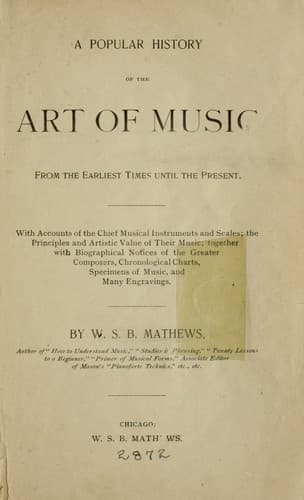
A Popular History of the Art of Music: From the Earliest Times Until the PresentMathews, W. S. B. (William Smythe Babcock)
History
A Popular History of the Art of Music: From the Earliest Times Until the Present
Mathews, W. S. B. (William Smythe Babcock)
Music -- History and criticism
Johannes Brahms was born at Hamburgh, May 7, 1833, the son of a fine
musician who was player upon the double bass in the orchestra there.
The boy was always intended for a musician, and his instruction was
taken in hand with so much success that at the age of fourteen he
played in public pieces by Bach and Beethoven, and a set of original
variations. At the age of twenty he was a master, and it was in this
year that he accompanied Remenyi, made the acquaintance of Joachim and
Liszt, and had a rarely appreciative notice from a master no less than
Robert Schumann himself, who in his _New Journal of Music_ said:
"He has come, a youth at whose cradle graces and heroes kept watch.
Sitting at the piano he began to unveil wonderful regions. We were
drawn into more and more magical circles by his playing, full of
genius, which made of the piano an orchestra of lamenting and jubilant
voices. There were sonatas, or rather veiled symphonies; songs whose
poetry might be understood without words; piano pieces both of a
demoniac nature and of the most graceful form; sonatas for piano and
violin; string quartettes, each so different from every other that
they seemed to flow from many different springs. Whenever he bends his
magic wand, there, when the powers of the orchestra and chorus lend
him their aid, further glimpses of the magic world will be revealed to
us. May the highest genius strengthen him! Meanwhile the spirit of
modesty dwells within him. His comrades greet him at his first
entrance into the world of art, where wounds may perhaps await him,
but bay and laurel also; we welcome him as a valiant warrior."
The next few years were spent by Brahms in directing orchestra and
chorus at Detmold and elsewhere, and in Switzerland, which has always
had great attraction for him. In 1859 he played in Leipsic his first
great pianoforte concerto; most of the criticisms thereon were,
however, such as now excite mirth. Lately he has played in Leipsic
again, conducted several of his works, and was greeted with the
reverence and enthusiasm due the greatest living representative of the
art of music. In 1862 Brahms located in Vienna, where he has almost
ever since resided. Mr. Louis Kestelborn, in "Famous Composers and
Their Works," says: "About thirty years ago the writer first saw
Brahms in his Swiss home; at that time he was of a rather delicate,
slim-looking figure, with a beardless face of ideal expression. Since
then he has changed in appearance, until now he looks the very image
of health, being stout and muscular, the noble manly face surrounded
by a full gray beard. The writer well remembers singing under his
direction, watching him conduct orchestra rehearsals, hearing him play
alone or with orchestra, listening to an after-dinner speech or
private conversation, observing him when attentively listening to
other works, and seeing the modest smile with which he accepted, or
rather declined, expressions of admiration."
Public-domain text, read in full here on John Shaqi.
Reviews
Reviews
No reviews yet
Be the first to share your thoughts on this work.
Elsewhere in the archive
Join the Discussion
Join the discussion
Sign in to leave a comment or review.
Sign InorCreate an account