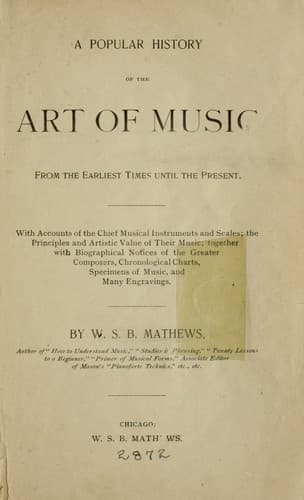
A Popular History of the Art of Music: From the Earliest Times Until the PresentMathews, W. S. B. (William Smythe Babcock)
History
A Popular History of the Art of Music: From the Earliest Times Until the Present
Mathews, W. S. B. (William Smythe Babcock)
Music -- History and criticism
The most important works of Brahms, aside from his "German Requiem,"
are four symphonies for orchestra, two concertos for pianoforte, a
concerto for violin and 'cello with orchestra, a violin concerto, many
songs, a variety of compositions for chamber, embracing a number for
unusual combinations of instruments (such as clarinet and horn with
piano), sonatas for piano solo, etc. In the songs he attains a simple
and direct expression, not surpassed in musical quality since
Schubert and Schumann; in the concertos he is more for music than for
display, which is merely to say that in conceiving the display of his
solo instrument, he has sought rather to display it at its best in a
musical sense than to exhibit its peculiar tricks of dexterity. As a
symphonist he follows classic form, and is more successful than any
other writer in the slow movements, a department in which most of the
later writers are distinctly weak, since in an idealized folk song
(which is the essential ideal of the symphonic slow movement) poverty
of imagination cannot be concealed by dexterity of thematic treatment
and modulation. As a writer for the pianoforte he has made important
enlargements of the technique, not alone in his arrangement of easier
compositions by earlier writers, but still more by original demands
upon the fingers, as illustrated in his great sets of variations.
Distinguished among German composers is Max Bruch (1838- ) who was
born at Cologne, and educated there and almost everywhere else in
Germany. Bruch is best known by his works for chorus with orchestra,
of which "Frithjof," "A Roman Song of Triumph," "The Song of the Three
Kings," "Odysseus," "Arminius" are best known. His concerto for violin
is also played in all parts of the world, but his opera of "Hermione"
made but a moderate success at Berlin in 1872. Riemann considers his
greatest works for mixed chorus to be "Odysseus," "Arminius," "The
Song of the Bell," and for male chorus "Frithjof," "Salamis" and "The
Normans." His style is closely wrought, musical, full of deep and
natural musical expression, and well colored instrumentation.
Anton Bruckner (1824- ) a highly gifted organist and composer, has
written seven symphonies, in which the style is very modern, and shows
the influence of the theatrical style of Wagner. He is a composer of
considerable vigor.
II. MUSIC IN RUSSIA.
Public-domain text, read in full here on John Shaqi.
Reviews
Reviews
No reviews yet
Be the first to share your thoughts on this work.
Elsewhere in the archive
Join the Discussion
Join the discussion
Sign in to leave a comment or review.
Sign InorCreate an account