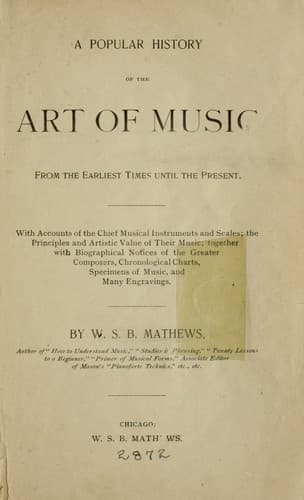
A Popular History of the Art of Music: From the Earliest Times Until the PresentMathews, W. S. B. (William Smythe Babcock)
History
A Popular History of the Art of Music: From the Earliest Times Until the Present
Mathews, W. S. B. (William Smythe Babcock)
Music -- History and criticism
There are two symphonies, both unfinished,
several dances for orchestra, a number of chamber compositions of
various combinations of instruments, a tarantella for orchestra, with
song and dance ("_La Kamarinskaia_"), etc. His operas, however, are
his lasting monument.
[Illustration: ANTON VON RUBINSTEIN.]
The next great name in the roll of Russian music is that of the
pianist, Anton von Rubinstein (1830-1895), who was born at
Wechwotynez, in Bessarabia. His father presently removed to Moscow,
where he carried on a manufactory of lead pencils. The boy Anton
showed such talent for music under the skillful and affectionate
teaching of his mother, that at the age of ten he was brought before
various musical authorities in Paris for opinions concerning his
talent. His concert life began almost immediately from this period.
His mother went with him, and wherever there were pauses of a few days
the studies were resumed, exactly as had been the case with Mozart,
long before. In 1848 he found a friend and appreciative companion in
the Princess Helene, and then he wrote several operas upon Russian
subjects, of which two were published--"Dimitri Donskoi" and "Toms der
Narr." The success of these works was such that in 1854 the composer
was given a subvention for further foreign study by the Princess
Helene and Count Wielhorski, upon which followed four brilliant years
of incessant activity as virtuoso pianist and composer, extending as
far as London and Paris. Rubinstein had already lived some years in
Berlin, where he was as well known as at home. Returning to Russia in
1859, he received important appointments as musical director, founded
the St. Petersburg musical conservatory, of which he remained the
director until 1867, when ensued a new series of concert journeys
covering Europe, and in 1872-1873 extending to America, where he had a
wonderful success, carrying back to Russia as proceeds of the American
tour the at that time unprecedented sum of $54,000.
Public-domain text, read in full here on John Shaqi.
Reviews
Reviews
No reviews yet
Be the first to share your thoughts on this work.
Elsewhere in the archive
Join the Discussion
Join the discussion
Sign in to leave a comment or review.
Sign InorCreate an account