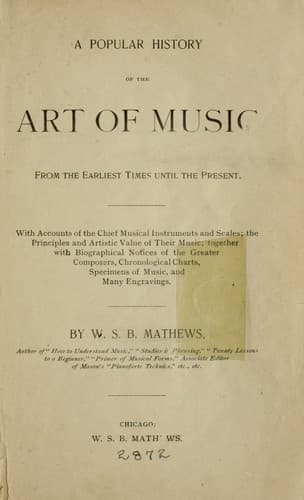
A Popular History of the Art of Music: From the Earliest Times Until the PresentMathews, W. S. B. (William Smythe Babcock)
History
A Popular History of the Art of Music: From the Earliest Times Until the Present
Mathews, W. S. B. (William Smythe Babcock)
Music -- History and criticism
The awakening of musical art has been remarkable in all parts of the
civilized world, and in many countries not previously distinguished in
music composers have arisen who have embodied the rhythms and spirit
of the national songs in their works, composed dramatic works upon
national subjects, and so have created a national school of music. In
some cases the works of these men have proven of world-wide
acceptance; in others they have set in operation musical life in their
own country, and have been followed quickly by younger composers
working in a more cosmopolitan vein, who have created works which have
been taken into the current of the world's music and bid fair to hold
an honorable position in the pantheon.
[Illustration: MICHAIL IVANOVITCH GLINKA.]
One of the most brilliant cases of this kind is Russia, that country
so vast, so powerful, so mysterious. The first composer in Russia to
distinguish himself and to create a national opera was Michail
Ivanovitch Glinka (1803-1877), born near Selna. His first schooling
was at the Adelsinstitute in St. Petersburg, where he distinguished
himself in languages. But presently, under the teaching of Bohme upon
the violin and Carl Mayer in pianoforte and theory, he showed the
musical stuff which was in him. Leaving Russia for his health, he
resided four years in Italy, constantly studying and incessantly
composing. On his way back to Russia he placed himself for a time
under the teaching of the distinguished S. Dehn in Berlin, in theory.
Dehn recognized his originality and encouraged him to write "Russian"
music. His first opera, "A Life for the Czar" (December 9, 1836), was
a great triumph. The subject was national, the contrast between Polish
and Russian subjects in the music was brilliant, and actual or
simulated folk songs gave a local coloring highly grateful to the
Russian audience. The work received innumerable repetitions and still
remains one of the most popular operatic works upon the Russian stage.
His next work, "Ruslan and Ludmilla," was also successful, and Liszt,
who happened to be in Russia at the moment of its production, accorded
the young composer distinguished praise. Berlioz took up the pen in
honor of Glinka and of his new Russian school of music, and so the
composer's powers were widely celebrated. During the remainder of his
life Glinka made long residences in the south, especially in Spain,
and several orchestral works, with Spanish coloring, represent this
portion of his creative career. His last years were spent in rural
life near St. Petersburgh, busy with new opera projects, and
especially seeking some rational manner of harmonizing the Russian
popular songs. Riemann calls Glinka "the Berlioz of Russia," in the
originality of his invention and his clever technique; and something
more, namely, that he created a national school of music for his
country. The list of his works is very long, embracing compositions in
almost every province.
Public-domain text, read in full here on John Shaqi.
Reviews
Reviews
No reviews yet
Be the first to share your thoughts on this work.
Elsewhere in the archive
Join the Discussion
Join the discussion
Sign in to leave a comment or review.
Sign InorCreate an account