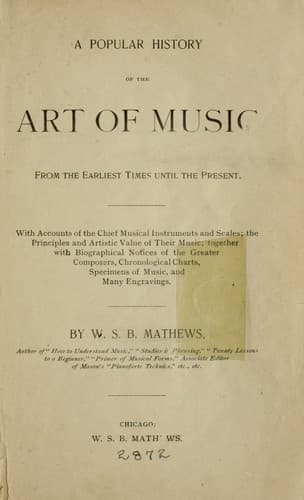
A Popular History of the Art of Music: From the Earliest Times Until the PresentMathews, W. S. B. (William Smythe Babcock)
History
A Popular History of the Art of Music: From the Earliest Times Until the Present
Mathews, W. S. B. (William Smythe Babcock)
Music -- History and criticism
Foremost of Scandinavian composers is Edvard Hagerup Grieg (1843- ),
who was born at Bergen, Norway, and received his early musical
education from his mother, who was an excellent pianist, and very
musical. By the advice of the celebrated violinist, Ole Bull, Grieg
was sent in 1858 to Leipsic for further instruction, where he became a
pupil of Moscheles, Hauptmann, Reinecke, Richter and Wenzel. In 1863
he pursued further studies under Gade at Copenhagen. In companionship
with a talented young composer, Ricard Nordraak, Grieg set himself, as
he says, "against the faded Scandinavianism of Gade and Mendelssohn
intermingled, and undertook to put into tones the real beauty,
strength and inner spirit of the northern folks-life." He composed in
many varieties of work, and in 1879 attained German recognition by
playing his own piano concerto at the Gewandhaus in Leipsic. Grieg's
works are full of poetry, easy and natural expression, and are
pervaded by northern coloring, so decided as in some cases to approach
what in speech is called dialect. Nevertheless, it is indubitable that
his music has distinctly enriched the world's stream of tone-poetry,
and introduced a new accent and voice. He has distinguished himself in
almost every department, in songs, choral work, chamber music,
symphonies, sonatas for piano and piano and violin, and orchestral
suites, of which perhaps his two "Peer Gynt" are the most celebrated.
In person Grieg is slight, fair-haired, with lovely deep blue eyes and
a charming manner. He is subject to pulmonary weakness, and is
compelled to reside much of his time in warmer climates than those of
his native land.
[Illustration: [autograph] Niels W. Gade]
An older composer than Grieg is Niels Wilhelm Gade (1817-1890), of
Copenhagen, who after a thorough musical education received in his
native city, attracted wider attention in 1841 by taking the prize for
his concert overture, "Night Sounds from Ossian," the judges being Fr.
Schneider and Spohr, the violinist. This gave Gade a royal stipendium,
with which he immediately betook himself to study at Leipsic, where he
came under the personal influence of Mendelssohn, an influence which
he never outgrew. At the death of Mendelssohn he was appointed
director of the Gewandhaus, but not proving in all respects
satisfactory he held the position only a part of one season. After the
death of Glaeser in 1861, Gade was made royal music director at
Copenhagen, a position which he filled many years. He was active as
composer in every direction, his published works embracing eight
symphonies, five overtures, two concertos for violin and orchestra,
three violin sonatas, several cantatas for mixed voices, soli and
orchestra, and many other works. The ultimate judgment of Gade as a
tone-poet is likely to be that while distinctly talented, he never
attained imagination of the first order.
Public-domain text, read in full here on John Shaqi.
Reviews
Reviews
No reviews yet
Be the first to share your thoughts on this work.
Elsewhere in the archive
Join the Discussion
Join the discussion
Sign in to leave a comment or review.
Sign InorCreate an account