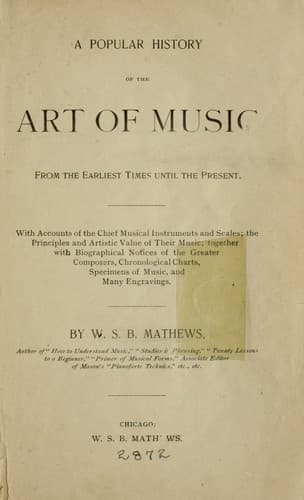
A Popular History of the Art of Music: From the Earliest Times Until the PresentMathews, W. S. B. (William Smythe Babcock)
History
A Popular History of the Art of Music: From the Earliest Times Until the Present
Mathews, W. S. B. (William Smythe Babcock)
Music -- History and criticism
Among the younger composers Christian Sinding (1856- ) is to be
mentioned. Besides many works for chamber, he has written one
symphony, which while not very original gives promise of better
productions later.
V. MUSIC IN ENGLAND.
The relation of England to the higher art of music has been peculiar.
In the sixteenth century and earlier it was one of the most musical
countries in Europe; but from the appearance of Haendel, about 1720,
German music and German composers absorbed public attention to the
exclusion of the natives--no one of whom, it may be added, evinced
creative powers of any high order. England was a liberal patron of all
the leading German masters, from Haydn, who wrote twelve symphonies
for the London Philharmonic, to Beethoven, whose ninth symphony was
written for the same society; Mendelssohn, whose "Elijah," was written
for the Birmingham festival, and Wagner, who received handsome
compensation for conducting a series of concerts in London. A little
past the middle of the present century, however, more creative
activity began to show itself among English composers, until at the
present time there are excellent English composers in all the leading
departments of musical production. The more celebrated names follow.
One of the most graceful and talented of English composers was Sir
William Sterndale Bennett (1816-1875), who came of a musical stock,
and was duly trained as a choir boy in King's Chapel, and at the Royal
Academy of Music. In 1836 he went to Leipsic, in order to profit by
the Gewandhaus concerts there and the friendship of Mendelssohn. Here
he produced a number of orchestral compositions which were so highly
esteemed that in 1853 the directorship of the Gewandhaus concerts was
offered him. After a short sojourn at Leipsic he returned to London,
where he ever after lived, highly honored as composer, pianist,
teacher and man. In 1856 he became the conductor of the London
Philharmonic concerts, and in 1866 principal of the Royal Academy of
Music. He was knighted in 1871, having previously been honored by
degrees from Cambridge and Oxford. He was professor of music in
Cambridge University from 1856 until his death. As a composer Bennett
was influenced by Mendelssohn, but he had much delicacy of fancy and a
certain originality of his own. His compositions embrace four
concertos for piano and orchestra, several concert overtures for
orchestra, one symphony, much chamber music, a cantata, "The May
Queen" (1858), "The Woman of Samaria" (1867), and a number of
occasional odes, anthems and part songs.
Public-domain text, read in full here on John Shaqi.
Reviews
Reviews
No reviews yet
Be the first to share your thoughts on this work.
Elsewhere in the archive
Join the Discussion
Join the discussion
Sign in to leave a comment or review.
Sign InorCreate an account