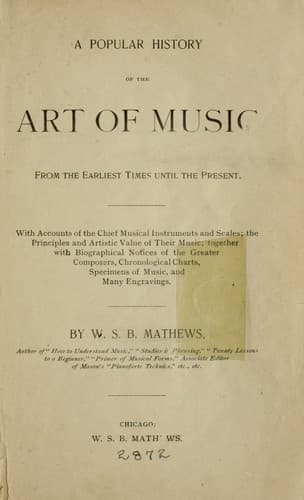
A Popular History of the Art of Music: From the Earliest Times Until the PresentMathews, W. S. B. (William Smythe Babcock)
History
A Popular History of the Art of Music: From the Earliest Times Until the Present
Mathews, W. S. B. (William Smythe Babcock)
Music -- History and criticism
The successor of Sterndale Bennett as principal of the Royal Academy
of Music was Sir George A. Macfarren (1813-1887), who although totally
blind for many years before his death, produced a greater number of
important compositions than any other English composer of the century.
He was educated in London, and in 1834 became one of the professors in
the Royal Academy of Music. His first opera was produced in 1838,
"Devil's Opera," "Don Quixote" (1836), "Jessy Lea" (1863) and
"Helvellyn" (1864). He wrote a number of cantatas for chorus and
orchestra, oratorios, "St. John the Baptist" (1873), "The
Resurrection" (1876), "Joseph" (1877), and other works of less
importance. There are also many anthems, several overtures and other
pieces for chamber. Personally he was kind-hearted, intelligent,
helpful and public spirited. The amount of work that he accomplished
under the greatest of disadvantages is wonderful, as well as its
generally superior quality. As a lecturer and teacher he was the
foremost musical Englishman of his time. His compositions are strong
and respectable, but not especially inspired.
The successor of Sir Geo. Macfarren in the principalship of the Royal
Academy of Music was Alexander Campbell Mackenzie (1847- ), the
youngest eminent English composer, but also the most successful and
promising. He was educated as a violinist, and resided at Edinburgh as
a teacher of the pianoforte and violin until his compositions
attracted the attention of his countrymen and induced his being called
to London. The most important compositions of Dr. Mackenzie up to the
present time are the operas "Colomba" (1883), "The Troubadour" (1886)
and the oratorio "The Rose of Sharon" (1884). There are several
cantatas, "Jason," "The Bride," "The Story of Sayid" (1886) and a
considerable number of orchestral pieces, of which two Scotch
rhapsodies and the overture to "Twelfth Night" are the best known. He
has also produced a violin concerto (played by Mr. Sarasate), and much
chamber music and songs. On the whole, Dr. Mackenzie seems the most
gifted English composer who has yet appeared.
[Illustration]
INDEX.
"Abel", 351
"Abou Hassan", 408
Academie de Musique, 238
Adam, 491
Adam de la Halle, 122
AEschylus, 55
"Africaine", 414
"Agnes von Hohenstaufen", 479
"Aida", 485
"Alceste", 333
"Alcidor", 479
"Allgemeine Musikalische Zeitung", 464
Amati, 201
Ambrosian Scales, 131
Anglo-Saxon Harp, 104
Anglo-Saxons, Music among, 96
"Anna Bolena", 482
Antiquity, Music in, 23
Apprentice Periods of Music, 22
Arabs and Saracens, 109
"Arianna", 224
Aristophanes, 57
Aristotle, 58, 65
Aristoxenus, 58
Arkadelt, 165
Art, Conditions of Its Development, 18
Art Forms, Qualities of, 20
"Ascanio", 494
Assyrian Harps, 45
Assyrians, Music among, 46
Auber, 488
Aurelian, 139
Bach, 265, 468
Bach as Melodist, 272
Bach, Emanuel, 282
Banjo, Ancient, 46
Bar in Vocal Music, 186
Bardi, Count of, 221
Bards, 89
Barytone, 196
"Basilius", 242
Public-domain text, read in full here on John Shaqi.
Reviews
Reviews
No reviews yet
Be the first to share your thoughts on this work.
Elsewhere in the archive
Join the Discussion
Join the discussion
Sign in to leave a comment or review.
Sign InorCreate an account