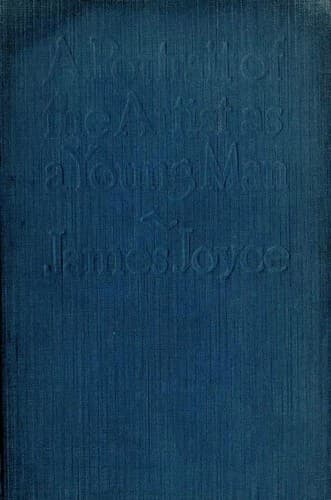
A Portrait of the Artist as a Young ManJoyce, James
General
A Portrait of the Artist as a Young Man
Joyce, James
Artists -- Fiction; Autobiographical fiction; Bildungsromans; Dublin (Ireland) -- Fiction; Young men -- Fiction
The names of articles of dress worn by women or of certain soft and
delicate stuffs used in their making brought always to his mind a
delicate and sinful perfume. As a boy he had imagined the reins by
which horses are driven as slender silken bands and it shocked him to
feel at Stradbrooke the greasy leather of harness. It had shocked him,
too, when he had felt for the first time beneath his tremulous fingers
the brittle texture of a woman’s stocking for, retaining nothing of all
he read save that which seemed to him an echo or a prophecy of his own
state, it was only amid softworded phrases or within rosesoft stuffs
that he dared to conceive of the soul or body of a woman moving with
tender life.
But the phrase on the priest’s lips was disingenuous for he knew that a
priest should not speak lightly on that theme. The phrase had been
spoken lightly with design and he felt that his face was being searched
by the eyes in the shadow. Whatever he had heard or read of the craft
of jesuits he had put aside frankly as not borne out by his own
experience. His masters, even when they had not attracted him, had
seemed to him always intelligent and serious priests, athletic and
high-spirited prefects. He thought of them as men who washed their
bodies briskly with cold water and wore clean cold linen. During all
the years he had lived among them in Clongowes and in Belvedere he had
received only two pandies and, though these had been dealt him in the
wrong, he knew that he had often escaped punishment. During all those
years he had never heard from any of his masters a flippant word: it
was they who had taught him christian doctrine and urged him to live a
good life and, when he had fallen into grievous sin, it was they who
had led him back to grace. Their presence had made him diffident of
himself when he was a muff in Clongowes and it had made him diffident
of himself also while he had held his equivocal position in Belvedere.
A constant sense of this had remained with him up to the last year of
his school life. He had never once disobeyed or allowed turbulent
companions to seduce him from his habit of quiet obedience; and, even
when he doubted some statement of a master, he had never presumed to
doubt openly. Lately some of their judgements had sounded a little
childish in his ears and had made him feel a regret and pity as though
he were slowly passing out of an accustomed world and were hearing its
language for the last time. One day when some boys had gathered round a
priest under the shed near the chapel, he had heard the priest say:
—I believe that Lord Macaulay was a man who probably never committed a
mortal sin in his life, that is to say, a deliberate mortal sin.
Some of the boys had then asked the priest if Victor Hugo were not the
greatest French writer. The priest had answered that Victor Hugo had
never written half so well when he had turned against the church as he
had written when he was a catholic.
Public-domain text, read in full here on John Shaqi.
Reviews
Reviews
No reviews yet
Be the first to share your thoughts on this work.
Elsewhere in the archive
Join the Discussion
Join the discussion
Sign in to leave a comment or review.
Sign InorCreate an account