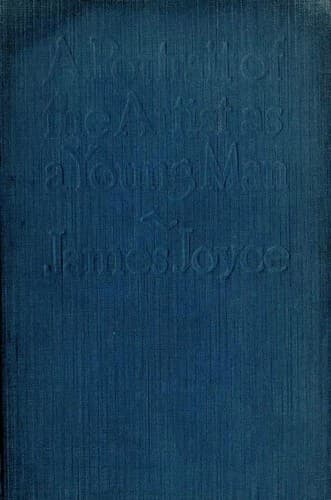
A Portrait of the Artist as a Young ManJoyce, James
General
A Portrait of the Artist as a Young Man
Joyce, James
Artists -- Fiction; Autobiographical fiction; Bildungsromans; Dublin (Ireland) -- Fiction; Young men -- Fiction
From the door of Byron’s public-house to the gate of Clontarf Chapel,
from the gate of Clontarf Chapel to the door of Byron’s public-house
and then back again to the chapel and then back again to the
public-house he had paced slowly at first, planting his steps
scrupulously in the spaces of the patchwork of the footpath, then
timing their fall to the fall of verses. A full hour had passed since
his father had gone in with Dan Crosby, the tutor, to find out for him
something about the university. For a full hour he had paced up and
down, waiting: but he could wait no longer.
He set off abruptly for the Bull, walking rapidly lest his father’s
shrill whistle might call him back; and in a few moments he had rounded
the curve at the police barrack and was safe.
Yes, his mother was hostile to the idea, as he had read from her
listless silence. Yet her mistrust pricked him more keenly than his
father’s pride and he thought coldly how he had watched the faith which
was fading down in his soul ageing and strengthening in her eyes. A dim
antagonism gathered force within him and darkened his mind as a cloud
against her disloyalty and when it passed, cloudlike, leaving his mind
serene and dutiful towards her again, he was made aware dimly and
without regret of a first noiseless sundering of their lives.
The university! So he had passed beyond the challenge of the sentries
who had stood as guardians of his boyhood and had sought to keep him
among them that he might be subject to them and serve their ends. Pride
after satisfaction uplifted him like long slow waves. The end he had
been born to serve yet did not see had led him to escape by an unseen
path and now it beckoned to him once more and a new adventure was about
to be opened to him. It seemed to him that he heard notes of fitful
music leaping upwards a tone and downwards a diminished fourth, upwards
a tone and downwards a major third, like triple-branching flames
leaping fitfully, flame after flame, out of a midnight wood. It was an
elfin prelude, endless and formless; and, as it grew wilder and faster,
the flames leaping out of time, he seemed to hear from under the boughs
and grasses wild creatures racing, their feet pattering like rain upon
the leaves. Their feet passed in pattering tumult over his mind, the
feet of hares and rabbits, the feet of harts and hinds and antelopes,
until he heard them no more and remembered only a proud cadence from
Newman:
—Whose feet are as the feet of harts and underneath the everlasting
arms.
The pride of that dim image brought back to his mind the dignity of the
office he had refused. All through his boyhood he had mused upon that
which he had so often thought to be his destiny and when the moment had
come for him to obey the call he had turned aside, obeying a wayward
instinct. Now time lay between: the oils of ordination would never
anoint his body. He had refused. Why?
Public-domain text, read in full here on John Shaqi.
Reviews
Reviews
No reviews yet
Be the first to share your thoughts on this work.
Elsewhere in the archive
Join the Discussion
Join the discussion
Sign in to leave a comment or review.
Sign InorCreate an account