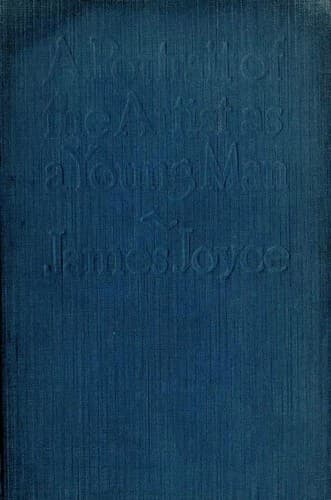
A Portrait of the Artist as a Young ManJoyce, James
General
A Portrait of the Artist as a Young Man
Joyce, James
Artists -- Fiction; Autobiographical fiction; Bildungsromans; Dublin (Ireland) -- Fiction; Young men -- Fiction
The last words of Davin’s story sang in his memory and the figure of
the woman in the story stood forth reflected in other figures of the
peasant women whom he had seen standing in the doorways at Clane as the
college cars drove by, as a type of her race and of his own, a batlike
soul waking to the consciousness of itself in darkness and secrecy and
loneliness and, through the eyes and voice and gesture of a woman
without guile, calling the stranger to her bed.
A hand was laid on his arm and a young voice cried:
—Ah, gentleman, your own girl, sir! The first handsel today, gentleman.
Buy that lovely bunch. Will you, gentleman?
The blue flowers which she lifted towards him and her young blue eyes
seemed to him at that instant images of guilelessness, and he halted
till the image had vanished and he saw only her ragged dress and damp
coarse hair and hoydenish face.
—Do, gentleman! Don’t forget your own girl, sir!
—I have no money, said Stephen.
—Buy them lovely ones, will you, sir? Only a penny.
—Did you hear what I said? asked Stephen, bending towards her. I told
you I had no money. I tell you again now.
—Well, sure, you will some day, sir, please God, the girl answered
after an instant.
—Possibly, said Stephen, but I don’t think it likely.
He left her quickly, fearing that her intimacy might turn to gibing and
wishing to be out of the way before she offered her ware to another, a
tourist from England or a student of Trinity. Grafton Street, along
which he walked, prolonged that moment of discouraged poverty. In the
roadway at the head of the street a slab was set to the memory of Wolfe
Tone and he remembered having been present with his father at its
laying. He remembered with bitterness that scene of tawdry tribute.
There were four French delegates in a brake and one, a plump smiling
young man, held, wedged on a stick, a card on which were printed the
words: _Vive l’Irlande!_
But the trees in Stephen’s Green were fragrant of rain and the
rainsodden earth gave forth its mortal odour, a faint incense rising
upward through the mould from many hearts. The soul of the gallant
venal city which his elders had told him of had shrunk with time to a
faint mortal odour rising from the earth and he knew that in a moment
when he entered the sombre college he would be conscious of a
corruption other than that of Buck Egan and Burnchapel Whaley.
It was too late to go upstairs to the French class. He crossed the hall
and took the corridor to the left which led to the physics theatre. The
corridor was dark and silent but not unwatchful. Why did he feel that
it was not unwatchful? Was it because he had heard that in Buck
Whaley’s time there was a secret staircase there? Or was the jesuit
house extra-territorial and was he walking among aliens? The Ireland of
Tone and of Parnell seemed to have receded in space.
Public-domain text, read in full here on John Shaqi.
Reviews
Reviews
No reviews yet
Be the first to share your thoughts on this work.
Elsewhere in the archive
Join the Discussion
Join the discussion
Sign in to leave a comment or review.
Sign InorCreate an account