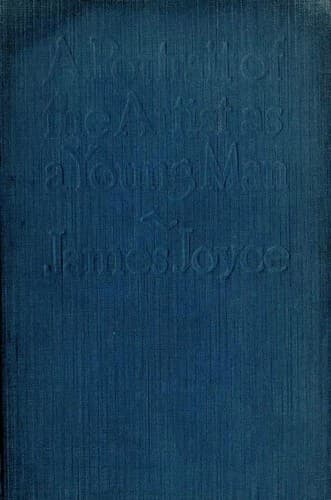
A Portrait of the Artist as a Young ManJoyce, James
General
A Portrait of the Artist as a Young Man
Joyce, James
Artists -- Fiction; Autobiographical fiction; Bildungsromans; Dublin (Ireland) -- Fiction; Young men -- Fiction
—Do you know what Ireland is? asked Stephen with cold violence. Ireland
is the old sow that eats her farrow.
Davin rose from his box and went towards the players, shaking his head
sadly. But in a moment his sadness left him and he was hotly disputing
with Cranly and the two players who had finished their game. A match of
four was arranged, Cranly insisting, however, that his ball should be
used. He let it rebound twice or thrice to his hand and struck it
strongly and swiftly towards the base of the alley, exclaiming in
answer to its thud:
—Your soul!
Stephen stood with Lynch till the score began to rise. Then he plucked
him by the sleeve to come away. Lynch obeyed, saying:
—Let us eke go, as Cranly has it.
Stephen smiled at this sidethrust.
They passed back through the garden and out through the hall where the
doddering porter was pinning up a hall notice in the frame. At the foot
of the steps they halted and Stephen took a packet of cigarettes from
his pocket and offered it to his companion.
—I know you are poor, he said.
—Damn your yellow insolence, answered Lynch.
This second proof of Lynch’s culture made Stephen smile again.
—It was a great day for European culture, he said, when you made up
your mind to swear in yellow.
They lit their cigarettes and turned to the right. After a pause
Stephen began:
—Aristotle has not defined pity and terror. I have. I say...
Lynch halted and said bluntly:
—Stop! I won’t listen! I am sick. I was out last night on a yellow
drunk with Horan and Goggins.
Stephen went on:
—Pity is the feeling which arrests the mind in the presence of
whatsoever is grave and constant in human sufferings and unites it with
the human sufferer. Terror is the feeling which arrests the mind in the
presence of whatsoever is grave and constant in human sufferings and
unites it with the secret cause.
—Repeat, said Lynch.
Stephen repeated the definitions slowly.
—A girl got into a hansom a few days ago, he went on, in London. She
was on her way to meet her mother whom she had not seen for many years.
At the corner of a street the shaft of a lorry shivered the window of
the hansom in the shape of a star. A long fine needle of the shivered
glass pierced her heart. She died on the instant. The reporter called
it a tragic death. It is not. It is remote from terror and pity
according to the terms of my definitions.
—The tragic emotion, in fact, is a face looking two ways, towards
terror and towards pity, both of which are phases of it. You see I use
the word _arrest_. I mean that the tragic emotion is static. Or rather
the dramatic emotion is. The feelings excited by improper art are
kinetic, desire or loathing. Desire urges us to possess, to go to
something; loathing urges us to abandon, to go from something. The arts
which excite them, pornographical or didactic, are therefore improper
arts. The esthetic emotion (I used the general term) is therefore
static. The mind is arrested and raised above desire and loathing.
Public-domain text, read in full here on John Shaqi.
Reviews
Reviews
No reviews yet
Be the first to share your thoughts on this work.
Elsewhere in the archive
Join the Discussion
Join the discussion
Sign in to leave a comment or review.
Sign InorCreate an account