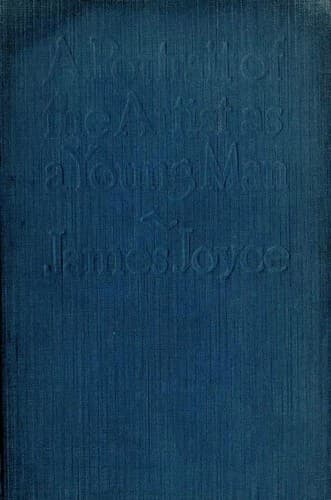
A Portrait of the Artist as a Young ManJoyce, James
General
A Portrait of the Artist as a Young Man
Joyce, James
Artists -- Fiction; Autobiographical fiction; Bildungsromans; Dublin (Ireland) -- Fiction; Young men -- Fiction
—You say that art must not excite desire, said Lynch. I told you that
one day I wrote my name in pencil on the backside of the Venus of
Praxiteles in the Museum. Was that not desire?
—I speak of normal natures, said Stephen. You also told me that when
you were a boy in that charming carmelite school you ate pieces of
dried cowdung.
Lynch broke again into a whinny of laughter and again rubbed both his
hands over his groins but without taking them from his pockets.
—O, I did! I did! he cried.
Stephen turned towards his companion and looked at him for a moment
boldly in the eyes. Lynch, recovering from his laughter, answered his
look from his humbled eyes. The long slender flattened skull beneath
the long pointed cap brought before Stephen’s mind the image of a
hooded reptile. The eyes, too, were reptile-like in glint and gaze. Yet
at that instant, humbled and alert in their look, they were lit by one
tiny human point, the window of a shrivelled soul, poignant and
selfembittered.
—As for that, Stephen said in polite parenthesis, we are all animals. I
also am an animal.
—You are, said Lynch.
—But we are just now in a mental world, Stephen continued. The desire
and loathing excited by improper esthetic means are really not esthetic
emotions not only because they are kinetic in character but also
because they are not more than physical. Our flesh shrinks from what it
dreads and responds to the stimulus of what it desires by a purely
reflex action of the nervous system. Our eyelid closes before we are
aware that the fly is about to enter our eye.
—Not always, said Lynch critically.
—In the same way, said Stephen, your flesh responded to the stimulus of
a naked statue, but it was, I say, simply a reflex action of the
nerves. Beauty expressed by the artist cannot awaken in us an emotion
which is kinetic or a sensation which is purely physical. It awakens,
or ought to awaken, or induces, or ought to induce, an esthetic stasis,
an ideal pity or an ideal terror, a stasis called forth, prolonged, and
at last dissolved by what I call the rhythm of beauty.
—What is that exactly? asked Lynch.
—Rhythm, said Stephen, is the first formal esthetic relation of part to
part in any esthetic whole or of an esthetic whole to its part or parts
or of any part to the esthetic whole of which it is a part.
—If that is rhythm, said Lynch, let me hear what you call beauty; and,
please remember, though I did eat a cake of cowdung once, that I admire
only beauty.
Stephen raised his cap as if in greeting. Then, blushing slightly, he
laid his hand on Lynch’s thick tweed sleeve.
—We are right, he said, and the others are wrong. To speak of these
things and to try to understand their nature and, having understood it,
to try slowly and humbly and constantly to express, to press out again,
from the gross earth or what it brings forth, from sound and shape and
colour which are the prison gates of our soul, an image of the beauty
we have come to understand—that is art.
Public-domain text, read in full here on John Shaqi.
Reviews
Reviews
No reviews yet
Be the first to share your thoughts on this work.
Elsewhere in the archive
Join the Discussion
Join the discussion
Sign in to leave a comment or review.
Sign InorCreate an account