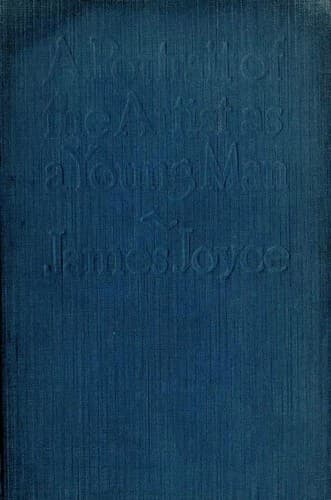
A Portrait of the Artist as a Young ManJoyce, James
General
A Portrait of the Artist as a Young Man
Joyce, James
Artists -- Fiction; Autobiographical fiction; Bildungsromans; Dublin (Ireland) -- Fiction; Young men -- Fiction
—To think that that yellow pancake-eating excrement can get a good job,
he said at length, and I have to smoke cheap cigarettes!
They turned their faces towards Merrion Square and went for a little in
silence.
—To finish what I was saying about beauty, said Stephen, the most
satisfying relations of the sensible must therefore correspond to the
necessary phases of artistic apprehension. Find these and you find the
qualities of universal beauty. Aquinas says: _Ad pulcritudinem tria
requiruntur integritas, consonantia, claritas._ I translate it so:
_Three things are needed for beauty, wholeness, harmony and radiance._
Do these correspond to the phases of apprehension? Are you following?
—Of course, I am, said Lynch. If you think I have an excrementitious
intelligence run after Donovan and ask him to listen to you.
Stephen pointed to a basket which a butcher’s boy had slung inverted on
his head.
—Look at that basket, he said.
—I see it, said Lynch.
—In order to see that basket, said Stephen, your mind first of all
separates the basket from the rest of the visible universe which is not
the basket. The first phase of apprehension is a bounding line drawn
about the object to be apprehended. An esthetic image is presented to
us either in space or in time. What is audible is presented in time,
what is visible is presented in space. But temporal or spatial, the
esthetic image is first luminously apprehended as selfbounded and
selfcontained upon the immeasurable background of space or time which
is not it. You apprehended it as _one_ thing. You see it as one whole.
You apprehend its wholeness. That is _integritas._
—Bull’s eye! said Lynch, laughing. Go on.
—Then, said Stephen, you pass from point to point, led by its formal
lines; you apprehend it as balanced part against part within its
limits; you feel the rhythm of its structure. In other words, the
synthesis of immediate perception is followed by the analysis of
apprehension. Having first felt that it is _one_ thing you feel now
that it is a _thing_. You apprehend it as complex, multiple, divisible,
separable, made up of its parts, the result of its parts and their sum,
harmonious. That is _consonantia_.
—Bull’s eye again! said Lynch wittily. Tell me now what is _claritas_
and you win the cigar.
Public-domain text, read in full here on John Shaqi.
Reviews
Reviews
No reviews yet
Be the first to share your thoughts on this work.
Elsewhere in the archive
Join the Discussion
Join the discussion
Sign in to leave a comment or review.
Sign InorCreate an account