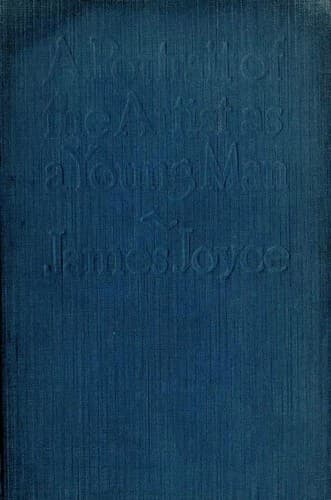
A Portrait of the Artist as a Young ManJoyce, James
General
A Portrait of the Artist as a Young Man
Joyce, James
Artists -- Fiction; Autobiographical fiction; Bildungsromans; Dublin (Ireland) -- Fiction; Young men -- Fiction
—The connotation of the word, Stephen said, is rather vague. Aquinas
uses a term which seems to be inexact. It baffled me for a long time.
It would lead you to believe that he had in mind symbolism or idealism,
the supreme quality of beauty being a light from some other world, the
idea of which the matter is but the shadow, the reality of which it is
but the symbol. I thought he might mean that _claritas_ is the artistic
discovery and representation of the divine purpose in anything or a
force of generalization which would make the esthetic image a universal
one, make it outshine its proper conditions. But that is literary talk.
I understand it so. When you have apprehended that basket as one thing
and have then analysed it according to its form and apprehended it as a
thing you make the only synthesis which is logically and esthetically
permissible. You see that it is that thing which it is and no other
thing. The radiance of which he speaks in the scholastic _quidditas_,
the _whatness_ of a thing. This supreme quality is felt by the artist
when the esthetic image is first conceived in his imagination. The mind
in that mysterious instant Shelley likened beautifully to a fading
coal. The instant wherein that supreme quality of beauty, the clear
radiance of the esthetic image, is apprehended luminously by the mind
which has been arrested by its wholeness and fascinated by its harmony
is the luminous silent stasis of esthetic pleasure, a spiritual state
very like to that cardiac condition which the Italian physiologist
Luigi Galvani, using a phrase almost as beautiful as Shelley’s, called
the enchantment of the heart.
Stephen paused and, though his companion did not speak, felt that his
words had called up around them a thought-enchanted silence.
—What I have said, he began again, refers to beauty in the wider sense
of the word, in the sense which the word has in the literary tradition.
In the marketplace it has another sense. When we speak of beauty in the
second sense of the term our judgement is influenced in the first place
by the art itself and by the form of that art. The image, it is clear,
must be set between the mind or senses of the artist himself and the
mind or senses of others. If you bear this in memory you will see that
art necessarily divides itself into three forms progressing from one to
the next. These forms are: the lyrical form, the form wherein the
artist presents his image in immediate relation to himself; the epical
form, the form wherein he presents his image in mediate relation to
himself and to others; the dramatic form, the form wherein he presents
his image in immediate relation to others.
—That you told me a few nights ago, said Lynch, and we began the famous
discussion.
Public-domain text, read in full here on John Shaqi.
Reviews
Reviews
No reviews yet
Be the first to share your thoughts on this work.
Elsewhere in the archive
Join the Discussion
Join the discussion
Sign in to leave a comment or review.
Sign InorCreate an account