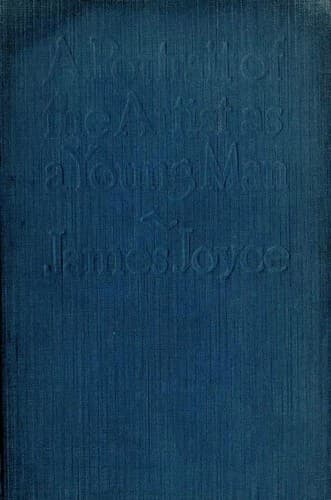
A Portrait of the Artist as a Young ManJoyce, James
General
A Portrait of the Artist as a Young Man
Joyce, James
Artists -- Fiction; Autobiographical fiction; Bildungsromans; Dublin (Ireland) -- Fiction; Young men -- Fiction
Cranly smiled and said kindly:
—The captain has only one love: sir Walter Scott. Isn’t that so,
captain?
—What are you reading now, captain? Dixon asked. _The Bride of
Lammermoor?_
—I love old Scott, the flexible lips said, I think he writes something
lovely. There is no writer can touch sir Walter Scott.
He moved a thin shrunken brown hand gently in the air in time to his
praise and his thin quick eyelids beat often over his sad eyes.
Sadder to Stephen’s ear was his speech: a genteel accent, low and
moist, marred by errors, and, listening to it, he wondered was the
story true and was the thin blood that flowed in his shrunken frame
noble and come of an incestuous love?
The park trees were heavy with rain; and rain fell still and ever in
the lake, lying grey like a shield. A game of swans flew there and the
water and the shore beneath were fouled with their greenwhite slime.
They embraced softly, impelled by the grey rainy light, the wet silent
trees, the shieldlike witnessing lake, the swans. They embraced without
joy or passion, his arm about his sister’s neck. A grey woollen cloak
was wrapped athwart her from her shoulder to her waist and her fair
head was bent in willing shame. He had loose redbrown hair and tender
shapely strong freckled hands. Face? There was no face seen. The
brother’s face was bent upon her fair rain-fragrant hair. The hand
freckled and strong and shapely and caressing was Davin’s hand.
He frowned angrily upon his thought and on the shrivelled mannikin who
had called it forth. His father’s gibes at the Bantry gang leaped out
of his memory. He held them at a distance and brooded uneasily on his
own thought again. Why were they not Cranly’s hands? Had Davin’s
simplicity and innocence stung him more secretly?
He walked on across the hall with Dixon, leaving Cranly to take leave
elaborately of the dwarf.
Under the colonnade Temple was standing in the midst of a little group
of students. One of them cried:
—Dixon, come over till you hear. Temple is in grand form.
Temple turned on him his dark gipsy eyes.
—You’re a hypocrite, O’Keeffe, he said. And Dixon is a smiler. By hell,
I think that’s a good literary expression.
He laughed slily, looking in Stephen’s face, repeating:
—By hell, I’m delighted with that name. A smiler.
A stout student who stood below them on the steps said:
—Come back to the mistress, Temple. We want to hear about that.
—He had, faith, Temple said. And he was a married man too. And all the
priests used to be dining there. By hell, I think they all had a touch.
—We shall call it riding a hack to spare the hunter, said Dixon.
—Tell us, Temple, O’Keeffe said, how many quarts of porter have you in
you?
—All your intellectual soul is in that phrase, O’Keeffe, said Temple
with open scorn.
He moved with a shambling gait round the group and spoke to Stephen.
—Did you know that the Forsters are the kings of Belgium? he asked.
Public-domain text, read in full here on John Shaqi.
Reviews
Reviews
No reviews yet
Be the first to share your thoughts on this work.
Elsewhere in the archive
Join the Discussion
Join the discussion
Sign in to leave a comment or review.
Sign InorCreate an account