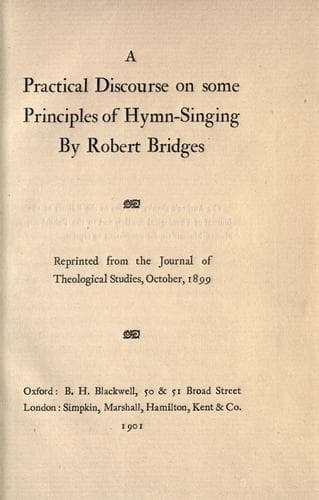
A Practical Discourse on Some Principles of Hymn-SingingBridges, Robert
Religion
A Practical Discourse on Some Principles of Hymn-Singing
Bridges, Robert
Church music -- Protestant churches; Hymns
I have already stated the ordinary objection to these tunes, that they
are stiff and out of date. Now it may be likely enough that they will
never be so universally popular in our country as the fine melodies
invented on the modern harmonic system, yet the idea that they are not
popular in character, and that modern people will not sing them, is a
mistake; there is plenty of evidence on this point. Nor must we judge
them by the incompetent, and I confess somewhat revolting aspect in which
they were offered to us by the Anglo-gregorianists of thirty years ago, a
presentment which has gone far to ruin their reputation; they are better
understood now, and may be heard here and there sung as they should be.
They are of great artistic merit and beauty; and instead of considering
them _a priori_ as uncongenial on the ground of antiquity, we should
rather be thinking of them that they were invented at a time when unison
singing was cultivated in the highest perfection, so much so that a large
number of these tunes are, on account of their elaborate and advanced
rhythm, not only far above the most intelligent taste of the minds with
which we have to deal, but are also so difficult of execution that there
are few trained choirs in the country that could render them well. To the
simpler tunes, however, these objections do not apply: in fact there are
only two objections that can be urged against them, and both of these
will be found on examination to be advantages.
The first objection is that they are not in the modern scale. Now as this
objection is only felt by persons who have cramped their musical
intelligence by an insufficient technical education, and cannot believe
that music is music unless they are modulating in and out of some key by
means of a sharp seventh;--and as the nature of the ecclesiastical modes
is too long a subject, and too abstruse for a paper of this sort, even if
I were competent to discuss it;--I shall therefore content myself by
stating that the ecclesiastical modes have, for melodic purposes (which
is all that we are considering), advantages over the modern scale, by
which they are so surpassed in harmonic opportunities. Even such a
thoroughgoing admirer of the modern system as Sir Hubert Parry writes on
this subject, that it 'is now quite obvious that for melodic purposes
such modes as the Doric and Phrygian were infinitely (_sic_) preferable
to the Ionic,' i.e. to our modern major keys[11]. And it will be evident
to every one how much music has of late years sought its charm in modal
forms, under the guise of national character.
The second objection is their free rhythm. They are not written in barred
time, and cannot without injury be reduced to it.
As this question affects also other classes of hymns, I will here say all
that I have to say, or have space to say, about the rhythm of hymn-tunes;
confining my remarks generally to the proper dignified rhythms.
Public-domain text, read in full here on John Shaqi.
Reviews
Reviews
No reviews yet
Be the first to share your thoughts on this work.
Join the Discussion
Join the discussion
Sign in to leave a comment or review.
Sign InorCreate an account