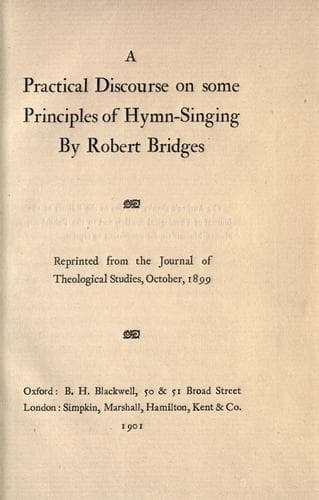
A Practical Discourse on Some Principles of Hymn-Singing — John Shaqi
A Practical Discourse on Some Principles of Hymn-SingingBridges, Robert
Religion
A Practical Discourse on Some Principles of Hymn-Singing
Bridges, Robert
Church music -- Protestant churches; Hymns
[19]This fact is of course generally recognized. The explanation in the
text is one which was elaborately illustrated by the Slade Professor at
Oxford, in his last course of lectures on painting.
[20]There is one point which I cannot pass over. It has become the
practice in modern books to put marks of musical expression to the
words, directing the congregation when to sing loud or soft. This
implies a habit of congregational performance the description of which
would make a companion picture to the organ gallery of 1830. It seems
to me a practice of inconceivable degradation: one asks in trembling if
it is to be extended to the Psalms. It is just as if the congregation
were school-children singing to please a musical inspector, and he a
stupid one.
[21]It must be due to unwillingness that comparatively so few of our
clergy can take their part in the service when it is musical. Village
schoolmasters tell me that two hours a week is sufficient in a few
months to bring all the children up to a standard of time and tune and
reading at sight that would suffice a minor canon.
PREFACE TO THE
YATTENDON HYMNAL
Among the old melodies which it is the chief object of this book to
restore to use, some will be found which will be quite new to the
public, while others will be familiar though in a somewhat different
form; and since the sources whence all the tunes are taken are well
known, and have been already largely drawn upon by the compilers of
Psalters and Hymnals, any melody which is new in this book may be
considered as having been hitherto overlooked or rejected, while in the
alternative case it is to be understood that the original cast of the
melody has at some former time been altered (frequently to suit the
English common metre to which it was not at first conformable), and is
now restored.
The plain-song tunes, of which an account is given in the preface to the
notes, and the few other old tunes which do not fall into either of the
two above-mentioned classes, were included for the sake of their
settings.
With respect to the vocal settings in four parts it may be said that, in
the numerous cases in which such settings were not added by the composer
of the melody, the editors have done their best to supply the want in a
suitable manner, and with some attempt towards the particular qualities
of workmanship upon which much of the beauty of the old vocal
counterpoint depends; and this latter aim has also governed the
composition of the six tunes not derived from old sources which have been
included in the work.
Public-domain text, read in full here on John Shaqi.
Reviews
Reviews
No reviews yet
Be the first to share your thoughts on this work.
Join the Discussion
Join the discussion
Sign in to leave a comment or review.
Sign InorCreate an account