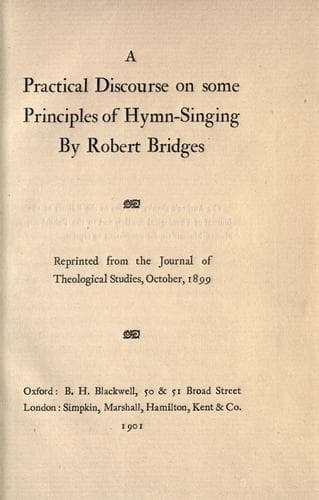
A Practical Discourse on Some Principles of Hymn-SingingBridges, Robert
Religion
A Practical Discourse on Some Principles of Hymn-Singing
Bridges, Robert
Church music -- Protestant churches; Hymns
There is one novelty which I am responsible for introducing, namely the
four-part vocal settings of certain early plain-song melodies. The later
plain-song tunes, such as No. 44, are, I suppose[27], as fit for this
treatment as any other tunes of the same date; but in the case of the
earlier melodies, which were composed before the invention of any
complete system of harmony, it is generally agreed that they should be
sung in unison, in fact the more elaborate of them cannot be sung
otherwise. To give four-part settings of any of these early tunes calls
therefore for an explanation, which I will give as briefly as possible.
When these tunes are sung, they are usually accompanied, and this implies
a harmonic treatment. Now the best harmonic treatment which they can have
is the Palestrinal, because that was the earliest complete system, and
therefore the nearest to their time, and also because we may rely on the
truth of its interpretation of the modes for the reason that Palestrina
had never heard any music that was not modal. A modern musician, if he
attempts to go back beyond Palestrina, must draw on his imagination, and
while his aim must be to produce something artistically and technically
less perfect than Palestrina's system, his work, when it is done, will
carry neither authority nor conviction.
If then we take Palestrina's harmonic interpretation of the modes, it
seems to me that there can be no objection to giving vocal parts to the
simpler hymns. If it is preferred to sing them in unison, the modal
settings will be a guide to the accompanist. But it is my opinion that
such settings as I offer will really please, and they may possibly do
something to bring these tunes, which have a unique, unmatchable beauty,
into favour with choirs that dislike the effort and waste of unison
singing. These settings offer no difficulty of execution all; _that is
necessary is that the under voices should know the melody_: and though
this is not generally thought requisite in a modern hymn, it is asking
nothing extra of a choir that would sing the plain-song tunes; for even
if they are sung in unison, they must first be known by heart (otherwise
their rhythmical freedom, which defies notation, and is indispensable to
their beauty, cannot be approached), and when once a choir has got thus
far, the under parts, being phrased with the melody, will easily follow
it. An explanation of the notation of these settings is given in the note
to Hymn 29. Congregational singing of hymns is much to be desired; but,
though difficult to obtain, it is not permissible to provoke it by
undignified music. Its only sound musical basis is good melody: good
melodies should therefore be offered to the people, such as it has been
the object of this book to bring together; and they should have as much
freedom and variety of rhythm as possible. If some of the good melodies
are, owing to their wide compass or other difficulty, unfit for
Public-domain text, read in full here on John Shaqi.
Reviews
Reviews
No reviews yet
Be the first to share your thoughts on this work.
Join the Discussion
Join the discussion
Sign in to leave a comment or review.
Sign InorCreate an account