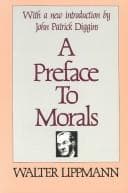
What I take into account first of all is the fact, which it seems to
me is indisputable, that for the modern populace the old rules are
becoming progressively unsuitable and the old symbols of hope and fear
progressively unreal. I ascribe that to the inherent character of the
modern ways of living. I conclude from this that if the populace must
be led, if it must have easily comprehended rules, if it must have
common symbols of hope and fear, the question is how are its leaders
to be developed, rules to be worked out, symbols created. The ultimate
question is not how the populace is to be ruled, but what the teachers
are to think. That is the question that has to be settled first: it is
the preface to everything else.
For while moralists are at sixes and sevens in their own [p322]
souls, not much can be done about morality, however high or low may
be our estimates of the popular intelligence and character. If it
were necessary to assume that ideals are relevant only if they are
universally attainable, it would be a waste of time to discuss them.
For it is evident enough that many, if not most men, must fail to
comprehend what modern morality implies. But to recognize this is not
to prophesy that the world is doomed unless men perform the miracle
of reverting to their ancestral tradition. This is not the first time
in the history of mankind when a revolution in the affairs of men
has produced chaos in the human spirit. The world can endure a good
deal of chaos. It always has. The ideal inherent in any age is never
realized completely: Greece, which we like to idealize as an oasis of
rationality, was only in some respects Hellenic; the Ages of Faith
were only somewhat Christian. The processes of nature and of society
go on somehow none the less. Men are born and they live and die with
some happiness and some sorrow though they neither envisage wholly nor
nearly approximate the ideals they pursue.
But if civilization is to be coherent and confident it must be _known_
in that civilization what its ideals are. There must exist in the form
of clearly available ideas an understanding of what the fulfilment of
the promise of that civilization might mean, an imaginative conception
of the good at which it might, and, if it is to flourish, at which
it must aim. That knowledge, though no one has it perfectly, and
though relatively few have it at all, is the principle of all order
and certainty in the life of that people. By it they can clarify the
practical conduct [p323] of life in some measure, and add immeasurably
to its dignity.
Public-domain text, read in full here on John Shaqi.
Reviews
Reviews
No reviews yet
Be the first to share your thoughts on this work.
Elsewhere in the archive
Join the Discussion
Join the discussion
Sign in to leave a comment or review.
Sign InorCreate an account