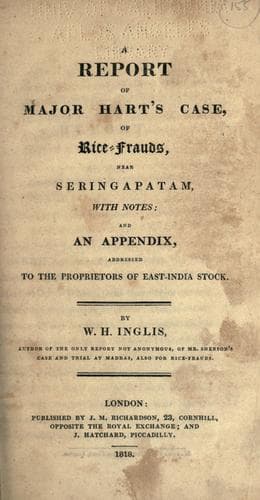
A report of Major Hart's case, of rice-frauds, near SeringapatamInglis, W. H.
History
A report of Major Hart's case, of rice-frauds, near Seringapatam
Inglis, W. H.
East India Company; Hart, George Vaughan, 1752-1832
But Major-general Macaulay scarce needed this reply, since it is Major
Hart himself who can affirm his own error. The Major says, "I shall not
however pretend to defend the act _acknowledged_ of my having carried to
the field a quantity of private grain.[A] No, my Lord, (Harris,) most
deeply and sensibly do I feel and deplore the _error_ of my
conduct.--Papers, p. 352.
[A] It will be maintained in the body of this Report, that Major
Hart did never carry to the field a quantity of private grain.
And yet, notwithstanding this _pretended_ acknowledgment of _real_
error, it is the Board of Controul which, in order to allow Major Hart
to hold private grain, must set aside the very regulation upon this
subject. The 39th Regulation says, "it being the principle of the
present system, by liberal and avowed allowances, to place this
department upon so respectable a footing as to leave no temptation to
seek for unauthorized advantages, the Commissary of Grain is not on any
account, directly or indirectly, to derive any other advantage or
emolument from this situation than the _salary_ fixed by Government. The
strictest economy is, therefore, to be observed in every expense
attending this department; and the disbursements and accounts of the
Commissary are to be attested on honour, as prescribed in the forms
annexed to these Regulations.--Papers, p. 17.
And the mighty Board of Controul, besides allowing Major Hart to hold
private grain, and therefore to reap the attendant profit on it _with
perfect security_, next considers this both as _another question_ and as
_not another question_. Thus the Board having said "whether he (Major
Hart) ought to have derived any profit upon the original price of the
rice, so in his possession, is another question," can yet add, "but
_suppose he ought not_, when he[B] openly supplied it to our army,
and was contented with much less (profit) than he might have obtained
with perfect security, we cannot think it a crime of the blackest
die.--Papers, p. 232.
[B] See in page 11, and query he or Captain Macleod; also
whether openly or covertly supplied, &c.
The Board continues "this, and the circumstance of his silence, from the
16th to the 22d of April, appear to us the only points of doubt in the
whole case, and a conduct doubtful only on two such points does not, in
our contemplation, warrant the sentence[C] that has been passed upon it,
with the consequences to his fortune and honour to which it has led."
Papers, p. 232.
[C] The propriety of Major Hart's dismission, after suspension
from the Company's service, is, perhaps, self-evident, and might
have been a ground of thanks; but who would have thanked the
Court of Directors for being now made to deem correct, what
formerly they were pleased to deem incorrect, viz. an Act of
Parliament, and the one cited on what are called the Mandamus
Papers!
Public-domain text, read in full here on John Shaqi.
Reviews
Reviews
No reviews yet
Be the first to share your thoughts on this work.
Join the Discussion
Join the discussion
Sign in to leave a comment or review.
Sign InorCreate an account