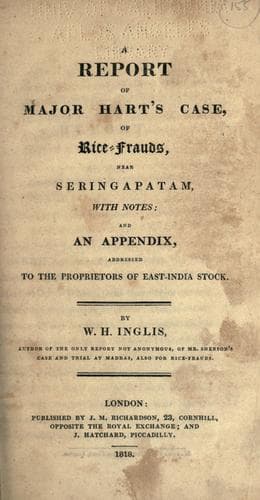
A report of Major Hart's case, of rice-frauds, near SeringapatamInglis, W. H.
History
A report of Major Hart's case, of rice-frauds, near Seringapatam
Inglis, W. H.
East India Company; Hart, George Vaughan, 1752-1832
From these several extracts we have now to gather, that if, on the 5th
of April, Major Hart had ten seers each man, equal to ten days rice, at
whole allowance, on the 15th he would have no bullock-loads, whatever,
remaining "in his possession." Wherefore, from the 16th of April to the
6th of May, (see in page. 17,) and, further, from this last date to the
18th following, (see in page 18), the fraud on the rice, "then in
camp," must have been, not only "exclusive of Major Hart's department,"
but in that of Captain Macleod, from whose stock "no issues had been
authorized." We have now to observe, that the real question becomes, not
whether Major Hart could hold private as well as public grain? but,
whether this could be done by Captain Macleod, and by him after his
having returned in his report both classes of grain as "the property of
government?" And we presume, once for all, on this nice point, that
there will not be urged the existence of one sort of regulation for a
Commissary of _Provisions_, as Captain Macleod is sometimes called, and
another for a Commissiary of _Grain_, as Major Hart was always called.
Contending that he ordered his private grain from Madras, less for
the army than for his private followers of it, Major Hart would rest
his order upon the affidavit of one of those followers, by name
Sadashevah Moodiliar. But this dubash, or confidential servant, will
herein-afterwards be shown, among other of Major Hart's head people,
as tampering with Subidar Enom Beg, during the intervals of this native
soldier's examination by the Committee of Inquiry.
To proceed more particularly with Captain Macleod.--It was he who,
having first disclosed to Major-General Macaulay, (the private instead
of public secretary to Lord Harris,) that Major Hart had a quantity of
private grain to dispose of, and who, next observing the surprise with
which his communication was received, does, third, and finally, request
Major-General Macaulay's "permission to inform Major Hart that he (Major
Hart) must, _in future_, communicate directly with me (Major-General
Macaulay) upon the subject." Major-General Macaulay subjoins, "to this I
assented;" but elsewhere explains, that "with the exception of the
conversation that took place with Captain Macleod, when he delivered the
original message, I held no communication with Major Hart, but _by
letter_." Papers, pp. 159 and 158.
Relative, indeed, to Captain Macleod the Major-General thinks it
equally right to explain, saying "Captain (now Colonel Macleod) well
knows my sentiments of his character. Long as he has been in England, it
has not happened to me _once to meet him_. But I retain my former
respect for his integrity." Papers, p. 369.
Public-domain text, read in full here on John Shaqi.
Reviews
Reviews
No reviews yet
Be the first to share your thoughts on this work.
Join the Discussion
Join the discussion
Sign in to leave a comment or review.
Sign InorCreate an account