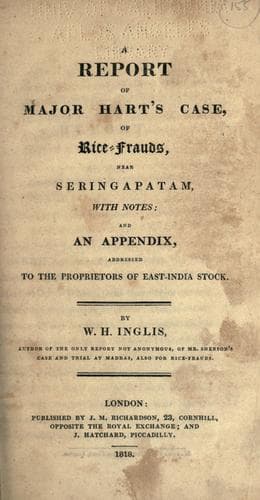
A report of Major Hart's case, of rice-frauds, near SeringapatamInglis, W. H.
History
A report of Major Hart's case, of rice-frauds, near Seringapatam
Inglis, W. H.
East India Company; Hart, George Vaughan, 1752-1832
We would observe upon this testimony of Enom Beg, that the
affidavit-dubash of Major Hart, Sadashevah Moodiliar, who is wont to
describe himself as "a writer in charge of the public servants in the
grain-department," is not, in our opinion, so important a personage as
Major Hart's head conicopoly Dunnacody, and this because the employment
of a head conicopoly is much more _official_ than that of a dubash,
however greatly any particular occasion, like the present, for instance,
may render the latter's services desirable. But in India it would
otherwise appear that the dubash is accounted by far the more important
personage of the two, at least if we can judge from Mr. Sherson's trial
at Madras, also for rice-frauds; for, on this trial Sir John Newbolt, as
third of three Judges, was pleased to argue, saying, 'Audy Narrain, (the
dubash of Mr. Sherson,) one of the persons offering the bribe, which is
_almost tantamount_ to naming Mr. Sherson himself.' Even in this case of
Major Hart there is what is not wholly dissimilar to bribery; namely,
where the conicopoly replies, 'that as he (Enom Beg) would probably be
sent for by the Committee sitting near the general's tent, he (the
conicopoly) desired him to keep favour on him.' The frequent occurrence
among native Indians of the word _lies_ is to be here regarded as an
Anglo-Orientalism. It is to the probability of Enom Beg and his
fellow-soldiers' testimonies over those of Major Hart and Captain
Macleod's head people, that attention shall safely be paid.
Relative to the benjarries and maistries of Captain Macleod, as well as
to Major Hart's head people, we must differ from the Committee of
Inquiry, where saying that "a _further_ examination of persons of those
descriptions will not tend to afford any new information on the
subject." Our cause of difference is, that neither Sadashevah and
Dunnacody, nor Sechiram and Narnapah, were _ever_ examined by this
Committee.
Major-General Macaulay "cannot conceive, under the strong case which
appears to be made out, how the government of this country and
Parliament can, _with a due regard to character_, abstain from a
revision of the whole question." Neither can we conceive how, in this
respect,--not the government (of the Board of Controul and Court of
Directors,) but--Parliament abstains.
APPENDIX.
_To the Proprietors of East-India Stock._
Major Hart, in his advertisement, (_Times_, 24th of April,) says "I
fear that I shall have no alternative but to appeal against such daily
slander to the laws of my country." In other words, he, who sought to
fight a duel with Major-Gen. Macaulay, fears. And may he fear!
But Major Hart dares not appeal to the laws of his country, were he even
slandered after the _daily_ manner of his own advertisement. Major Hart
is too old a soldier to have to learn, that
He who fights and runs away,
Lives to fight another day.
Public-domain text, read in full here on John Shaqi.
Reviews
Reviews
No reviews yet
Be the first to share your thoughts on this work.
Join the Discussion
Join the discussion
Sign in to leave a comment or review.
Sign InorCreate an account